Most traders have tried a journal and stopped. The usual reason is not laziness. It is that the journal never paid them back: pages of notes about what the market did, no change in what they did. A journal improves results only when it is built to answer questions about your behaviour, and when you read it on a schedule. This guide sets out what to record, how to keep it light enough to survive, and how to turn the entries into one change at a time.
Decide what the journal is for
A trading journal has one job: to show you the gap between what you planned and what you did, and what that gap costs. That sets the test for everything you put in it. If a field will never change a decision, drop it. If a field would expose a habit, keep it even when it is uncomfortable.
It also tells you what not to write. An essay on why the market moved is commentary, and no two commentaries can be compared.
What to record for each trade
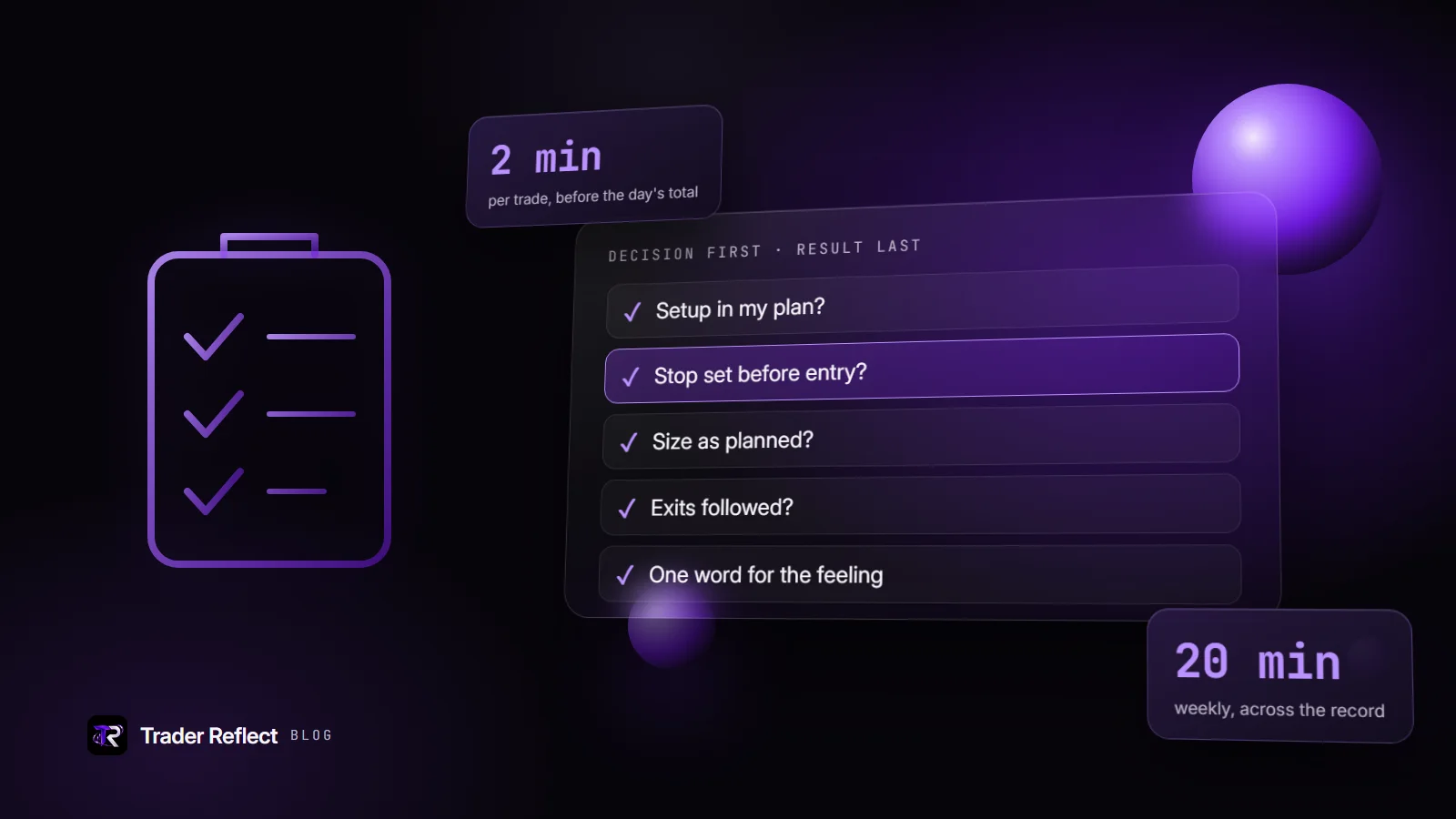
Keep the entry short enough to finish in a minute or two, right after the trade closes. Six fields cover most of the value:
- Setup. The named pattern from your plan, or "none" if there was not one. The "none" entries matter most.
- Planned risk and actual risk, in R. Where 1R is the amount you risked at your initial stop. If the two differ, you have found a sizing habit. The glossary entry on the R-multiple explains the unit.
- Stop set before entry? Yes or no.
- Plan followed? Yes or no, judged against your written rules, not against the result.
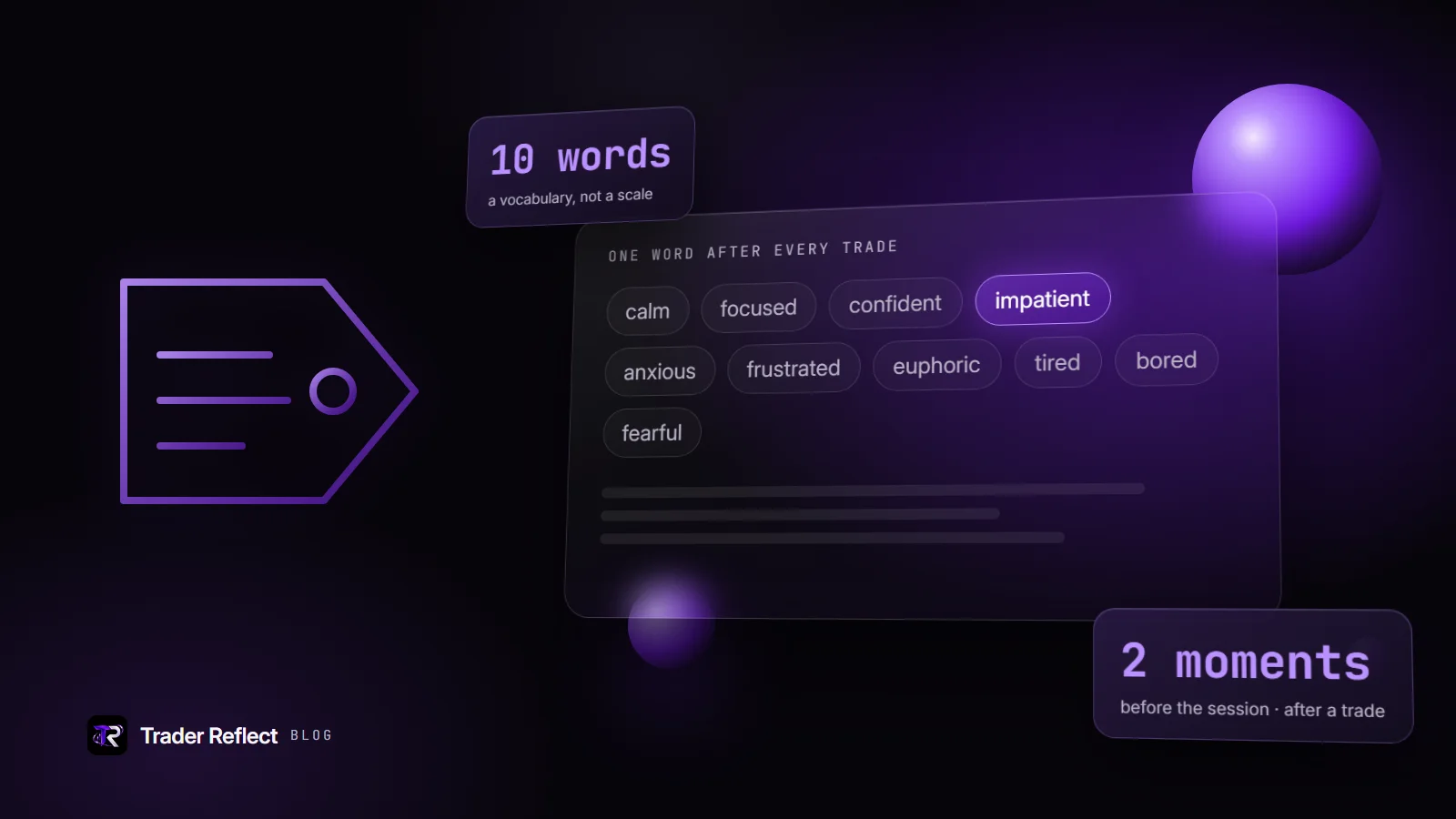
- One word for how you felt. Chosen from a short fixed list so it stays quick and comparable.
- Result in R.
Everything else is optional. A screenshot of the chart helps when you review a setup, but it is not the point. A fixed set of fields also stops you skipping the trades you would rather forget.
- RecordSix fields, right after the trade
Setup, planned and actual risk in R, stop before entry, plan followed, one feeling word, result in R.
- ReviewWeekly, from the whole record
Plan-followed rate, the cost of broken-plan trades, feelings and timing, each with its trade count.
- ChangeOne if-then rule for the costliest habit
A cue you notice and a physical action, then count occasions against kept next week.
Write before you analyse
One discipline separates a useful journal from a flattering one: record the plan-followed answer and the feeling before you look at the day's total. Once you have seen a large loss, every earlier decision looks worse, and once you have seen a win, it looks better. That is outcome bias, and a journal written in its shadow tells you about the outcome, not about the decision.
If you can, log the feeling twice a session: once on arrival and once as each trade closes. Naming a state in one word takes seconds. Laboratory work on affect labelling suggests that naming an emotion can reduce its intensity, though that research was not done on traders, so treat it as a reason to try the habit rather than a guarantee. The more reliable benefit is practical: the words become data you can group later.
Log the trades you skipped
A record of only the trades you took cannot show discipline, because discipline is partly the trades you did not take. Add a short line when you see a setup and pass, or when you feel the urge to chase and do not. One line is enough: what you saw and why you passed. Over a month this shows whether your passes follow your plan, and whether the urge to enter arrives at predictable times.
Review on a schedule
Writing an entry is the easy half. The review is where results change, and it needs a fixed slot. A workable rhythm:
- After each trade: the one-minute entry above.
- End of session: two lines. One thing done well, one thing to change tomorrow.
- Weekly, 20 to 30 minutes: read the week's entries in order, then group them.
- Monthly: compare against your plan and decide whether a rule changes.
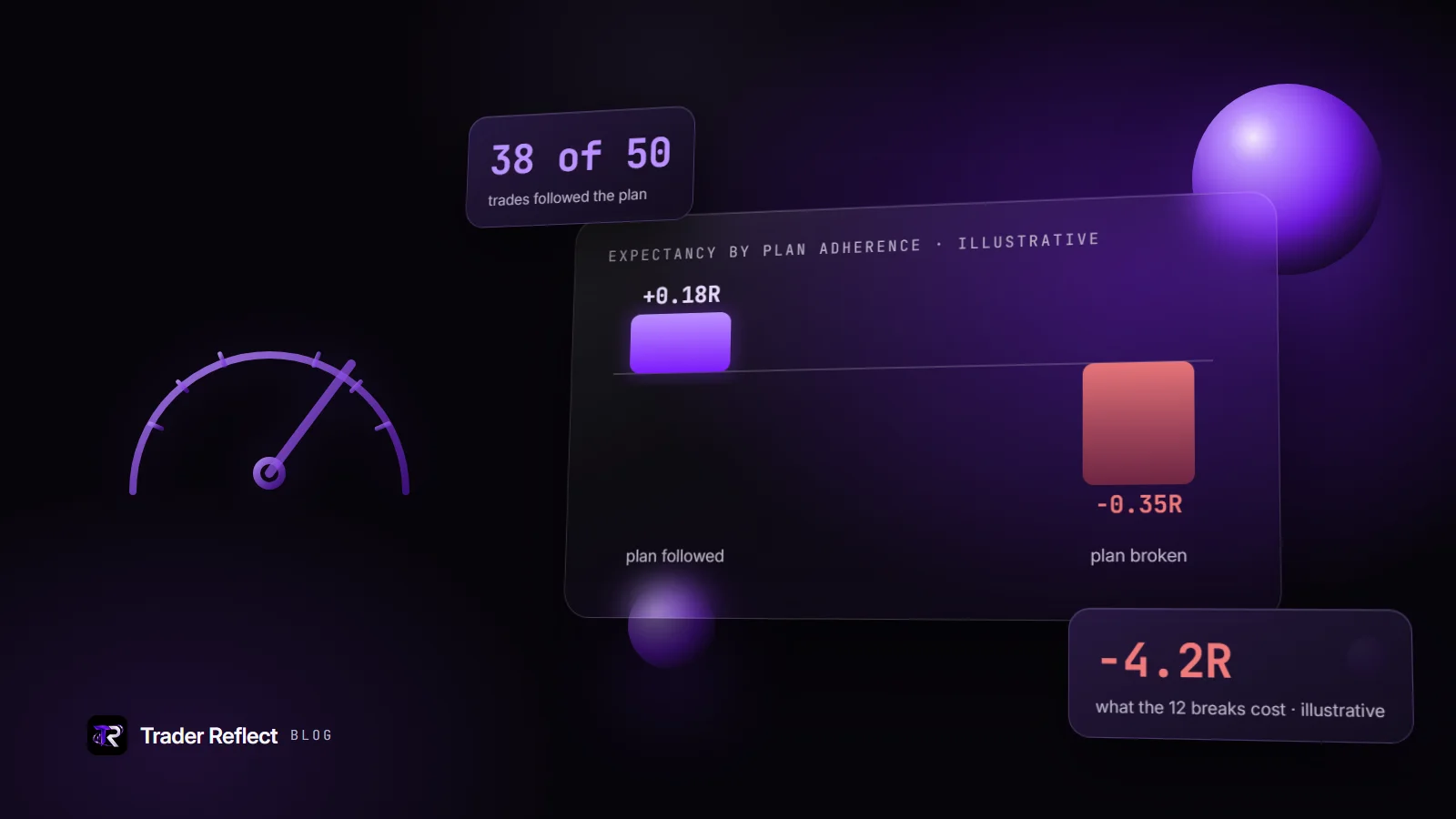
For the weekly pass, ask a small set of questions of the whole record. What was my plan-followed rate, and what was the average result in R of the trades where I did not follow the plan? Which of my feeling words came before my worst trades? Did my risk per trade rise after wins, or fall after losses? Did I trade worse in any hour or session? Each answer is a number you can compute, and each is more useful than a general sense that you "need more discipline". The post on measuring discipline as a trader shows how to do the first one.
Respect the sample
A journal produces patterns quickly and most of them are noise early on. Ten trades after a certain word, or a dozen in one hour, cannot tell you much, because one or two results can move the average. Before you act on a pattern, note how many trades it rests on and keep recording until the group is large enough to mean something. Thirty is a common minimum for a first look and it is a rule of thumb, not a threshold of proof. Why your win rate lies and the glossary entry on sample size cover why small groups mislead.
Change one thing
The most common way a journal fails is by finding six problems and trying to fix all of them. Pick the pattern that costs the most in R, and write one if-then rule for it: a cue you will notice, and a physical action. For example: if I close a second winning trade in a row, then the next trade is risked at exactly the planned amount. Then use the journal to check whether you kept the rule. Count the occasions the cue came up and the times you did what you said. If you kept it and the pattern is still costing you, the rule was wrong. If you did not keep it, the rule was too hard or too vague. Either is useful information, and neither shows up unless you recorded it.
Common ways journals go wrong
- Selective logging. Skipping the entries after bad days. Fix: log the uncomfortable ones first.
- Never reading it. Fix: put the weekly review in the calendar and treat it like a trade.
- Judging the plan by results. A good decision can lose. Fix: mark plan adherence against the rules, not the outcome.
Where Trader Reflect fits
If you log your trades in the Money Circle journal, Trader Reflect reads it back and looks for a fixed set of costly habits in your results, such as sizing after wins, quick re-entries after a loss and a late-session fade, and it shows the number of trades behind each finding. It does not replace the habit of keeping the record. It does the weekly arithmetic. You can open Trader Reflect from your Money Circle Journal; it is included with paid Money Circle membership, and you can see what membership includes. For what to put in the journal in the first place, Money Circle's guide on what a trading journal should record is a good companion, and the glossary has short entries on the trading journal and on journaling prompts.
Educational content, not financial advice. Trading involves risk of loss.