Many trading journals ask how you felt and offer a slider from one to ten. A single word does a different job. Research on affect labelling suggests that naming a feeling, rather than measuring it, can take some of the heat out of it, and a record of those words lets you see which states come before your weakest trades. This post covers what the evidence says, a short vocabulary to use, when to log it, and where the method runs out.
What affect labelling is
Lieberman et al. (2007) scanned people's brains while they looked at photographs of faces showing strong emotions. On some trials they chose a word for the emotion in the face, such as angry or scared. On others they did a different task with the same picture, such as matching it to another face. Choosing the emotion word was linked with lower activity in the amygdala, a region involved in alarm and emotional reactions, and higher activity in a part of the prefrontal cortex associated with regulating emotion. Putting the feeling into words appeared to dampen the response to it.
Two cautions matter here. First, this was a laboratory study with photographs, not traders with money at risk, so it shows a mechanism rather than a trading result. Second, the study compared labelling with other tasks, not with rating scales. The case against a slider is therefore an inference, not a tested finding: a slider asks how much, a word asks what, and it is the act of sorting a state into a category that the study links with the dampening. A number on a scale skips that step.
Expressive writing, the longer-form cousin
Pennebaker (1997) reviewed a line of studies in which people wrote about emotional experiences in short sessions over several days. Writing about what had happened, and how they felt about it, was associated with later benefits to health and wellbeing compared with writing about neutral topics. The benefit seemed to depend less on venting and more on turning the experience into language that made sense of it.
For a trader, expressive writing is the occasional long entry: a paragraph after a difficult week about what happened and why it got to you. The single emotion word is the minimal daily version of the same idea. It takes seconds, so you can do it every time, and because it is a fixed word rather than free text, you can count it later.
Why a short vocabulary works better than a scale
A score records intensity but not kind. A "6" after a loss could mean frustrated, fearful or simply tired, and those states can pull behaviour in different directions. Frustration might push you to re-enter quickly; fear might make you skip a setup that meets your rules; tiredness might make you miss an exit. A number blurs them together, and so does your record.
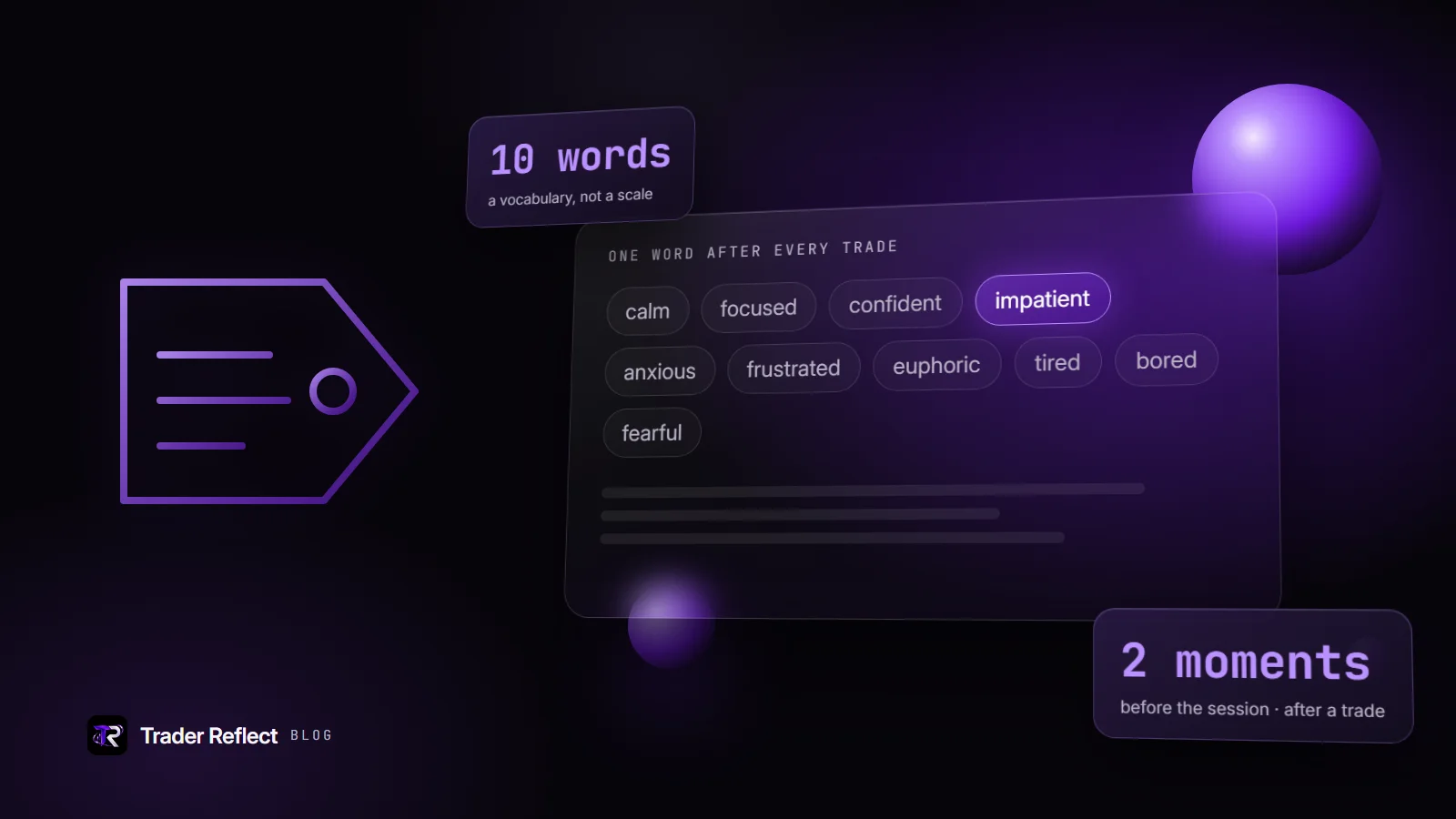
A short, fixed list solves two problems at once. It is quick to choose from in the moment, and because the words repeat, they can be grouped and counted. Here is an example vocabulary of ten words. Adapt it, but keep it short and keep it stable once you start.
- Calm: settled, no particular urge to act.
- Focused: attention on the plan and the chart, little else.
- Confident: trusting the setup without needing it to work.
- Impatient: wanting something to happen, waiting feels costly.
- Anxious: uneasy about what might go wrong.
- Frustrated: annoyed at the market, a missed move or yourself.
- Euphoric: elated, usually after a run of wins.
- Tired: low energy, slower to notice things.
- Bored: nothing happening, tempted to make something happen.
- Fearful: reluctant to act, or eager to get out.
If you keep reaching for a word that is not on the list, add it. Avoid renaming words halfway through, because "edgy" one month and "anxious" the next will split one state into two groups.
When to log it
Two moments are enough.
- Before the session. One word for how you arrive at the desk. This catches states that have nothing to do with the market. "Tired" belongs here: Killgore (2010) reviewed evidence that sleep deprivation impairs attention and decision-making. Writing the word at the start is easier than trying to notice the effect mid-session.
- Right after a trade closes. One word, written before you analyse the trade or check your running total for the day. Logging first keeps the label closer to the state and less coloured by the story you tell about the result.
That label then becomes the "before" state for your next trade. Money Circle's guide to what to record in a trading journal shows where an emotion field sits alongside entry, exit and risk.
- BeforeOne word for how you arrive
Catches states that have nothing to do with the market — tired, anxious, calm.
- AfterOne word as a trade closes
Written before you analyse the trade or check the day's total, so the label stays close to the state.
- ReviewRead the words against your results
Group trades by word and compare expectancy in R — once each group has enough trades to mean something.
Reading your labels in R
After a few weeks you can group trades by the label logged just before them: the pre-session word for the first trade, and the previous post-trade word for each one after. Then look at average results in R, where 1R is the amount risked on a trade.
Suppose you have 60 trades. The 34 taken after "calm" or "focused" total +6.8R, an average of +0.2R each. The 15 taken after "impatient" total −1.5R, an average of −0.1R. The 11 taken after "frustrated" total −8.8R, an average of −0.8R. Overall that is 6.8 − 1.5 − 8.8 = −3.5R across 60 trades. In this example, the 11 frustrated trades cost more than the 34 calm and focused trades made. That is the kind of pattern described in revenge trading: how to spot it in your own record, seen through the label rather than the clock.
The useful next step is a single plan tied to the label: if my last word was "frustrated", then I leave the desk for ten minutes before any new order. If-then plans for traders explains how to write one you can actually keep.
Watch for overlap with time of day. If most of your "tired" trades happen late in the session, a poor average could belong to the hour as much as to the feeling. When your edge fades shows how to look at results by hour and session so you can tell the two apart.
Limits worth knowing
- Self-report bias. You log what you are willing to admit. Some traders rarely write "euphoric" or "frustrated" even when it fits, which makes those groups look smaller than they are.
- Outcome colouring. A word written after seeing a large loss may describe the loss more than the state you traded in. Logging before analysing helps but does not remove this.
- Small samples. Eleven trades is a small group, and one or two large losses can drive its average. Treat an early pattern as a question to keep asking, not an answer.
- Cause is not shown. A state and a poor trade can both follow from the same market conditions. The label tells you where to look, not why it happened.
- Lab to desk. The research behind labelling and expressive writing was not done on traders. It suggests the habit is worth trying, nothing more.
Trader Reflect reads the emotion words in your Money Circle journal alongside your results, shows how expectancy in R moves with each one, and suggests one if-then action for the state that costs you most. You can open Trader Reflect from your Money Circle Journal; it is included with paid Money Circle membership, and you can see what membership includes.
Educational content, not financial advice. Trading involves risk of loss.