You close a losing trade, and within a minute you are in another one. It is bigger than usual, the setup is half-formed, and the thought behind it is not "this meets my plan" but "I need that back". That is revenge trading. It is common, it is expensive, and it is rarely fixed by resolving to be more careful. This post covers how to recognise it, why it is hard to stop in the moment, and a short set of rules that work because they are decided in advance.
If you want to measure it in your own history first, the earlier post on revenge trading in your own trade record shows the arithmetic. This one is about what to do at the desk.
What it looks like
Revenge trading is defined by its motive, not by a fixed pattern. But the motive leaves marks you can learn to spot.
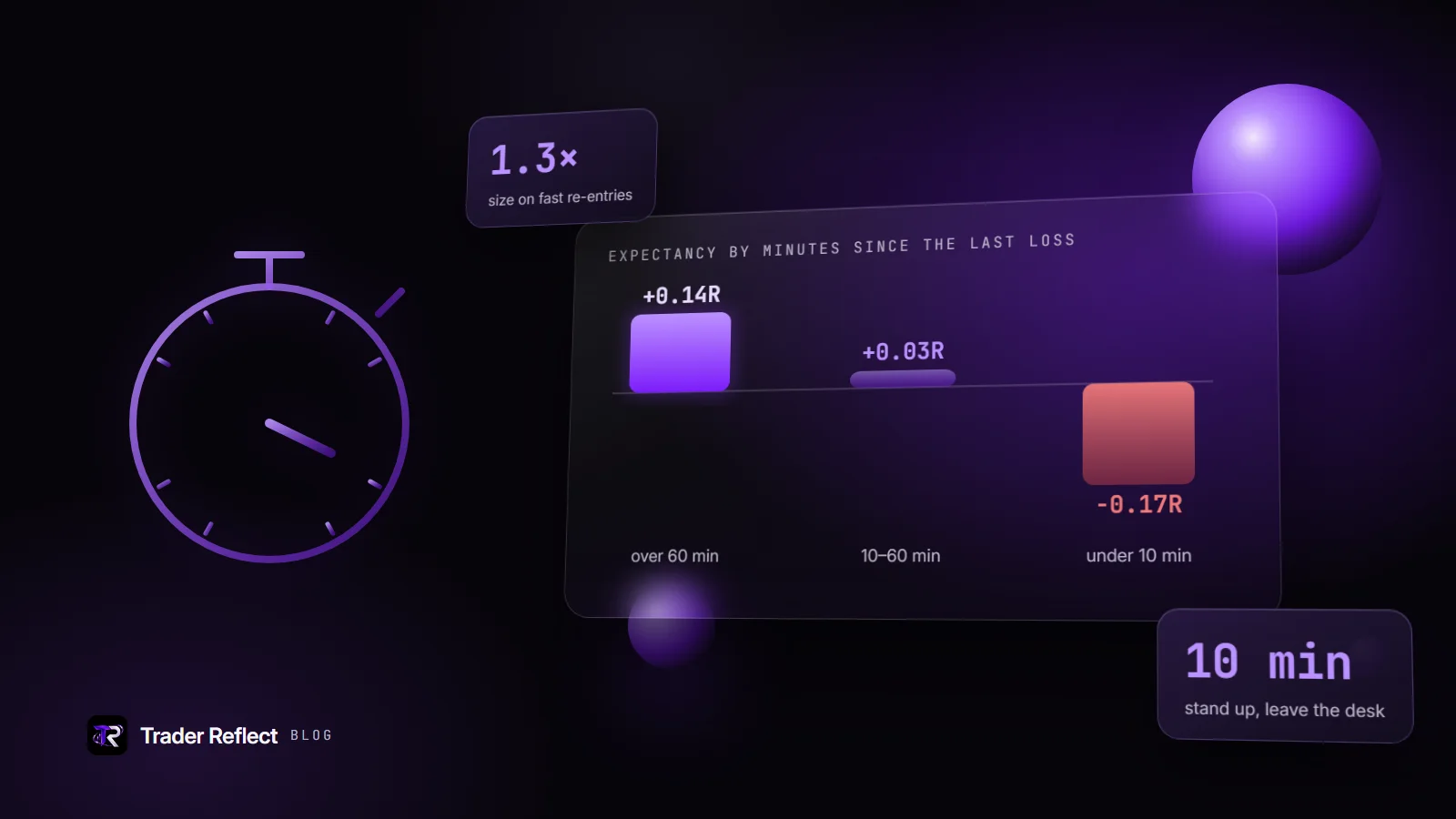
- Speed. The next entry comes within minutes of a loss, much faster than your normal gap between trades.
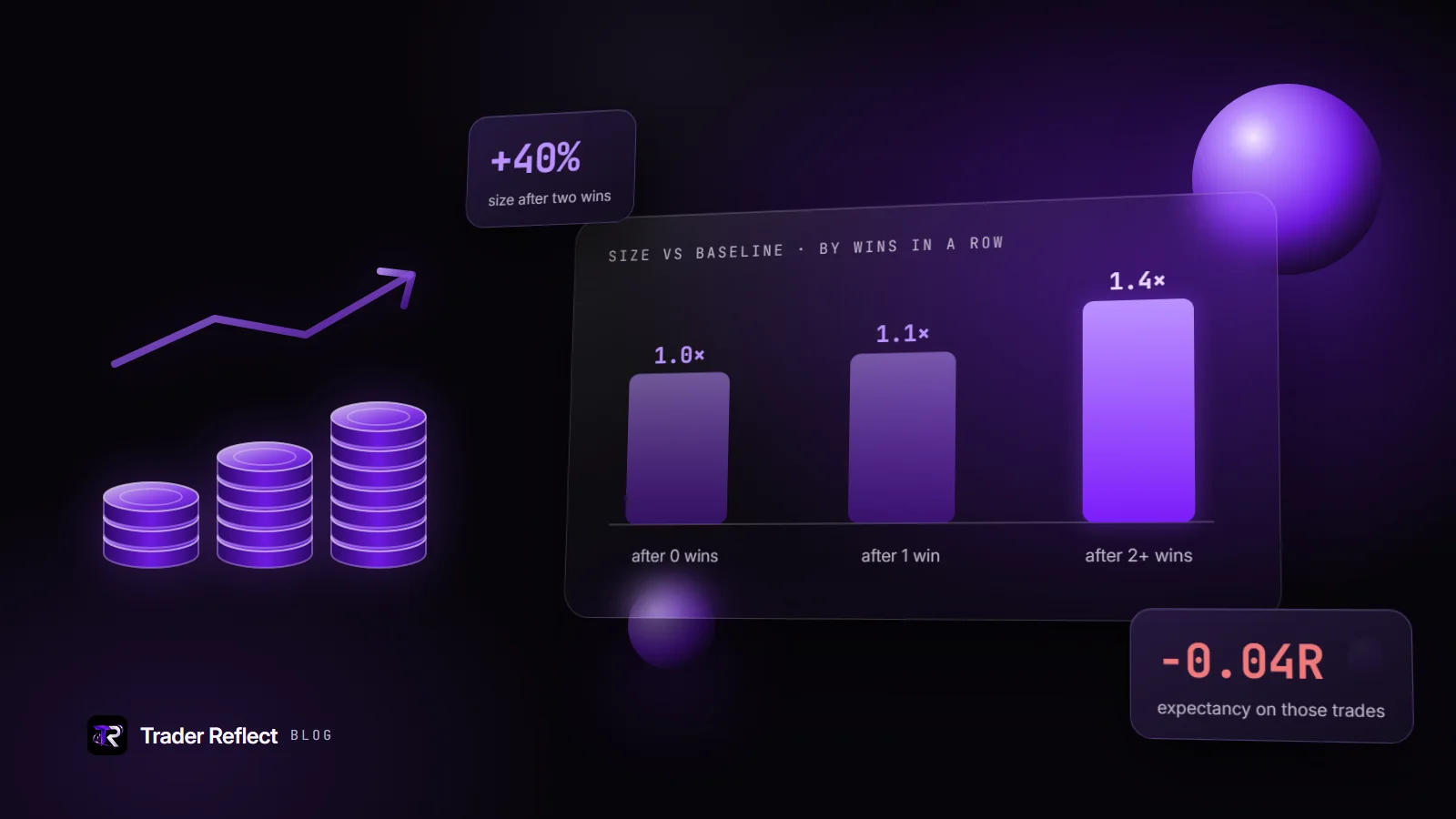
- Size. Risk rises above what your plan allows, because a bigger position promises a faster recovery.
- Thin reasoning. You can state the entry, but not which rule it satisfies. The justification is about the account, not the chart.
- Wider or missing stops. The stop is moved or never placed, because a second stop-out would feel unbearable.
- Body signals. Faster breathing, a tight jaw, a stronger urge to click. These are personal, and writing yours down when calm is worth ten minutes.
It does not require a big loss. A run of small losses, or one that felt unfair, can trigger it, even a loss within your plan.
Why willpower is the wrong tool
After a loss, the faculties you need to hold back an impulse are the ones most affected by stress. Telling yourself to stay calm asks the weakened part of you to overrule the part that is pushing. That is why the effective defences are not thoughts but changes to the situation: a rule decided earlier, a physical action, a delay.
Research on implementation intentions, plans of the form "if this happens, then I do that", finds that linking a specific cue to a specific action helps people follow through compared with a goal alone (Gollwitzer and Sheeran's meta-analysis is the standard reference). The research is general, not specific to trading, but the logic suits this problem well: the cue, a losing trade closing, is obvious and you will notice it.
- Cool-offA loss closes: leave the desk
No new entry for a fixed time, such as ten minutes, spent away from the screen.
- TestOne line before the next entry
Which setup in my plan is this, and where is the invalidation? No line, no trade.
- SizeThe planned size, whatever happened last
If the plan risks 1R, the trade risks 1R.
- StopA limit that ends the session
A set number of losses, or a set loss in R, decided while calm.
Four rules that interrupt it
Write these down before the next session. Each is checkable afterwards.
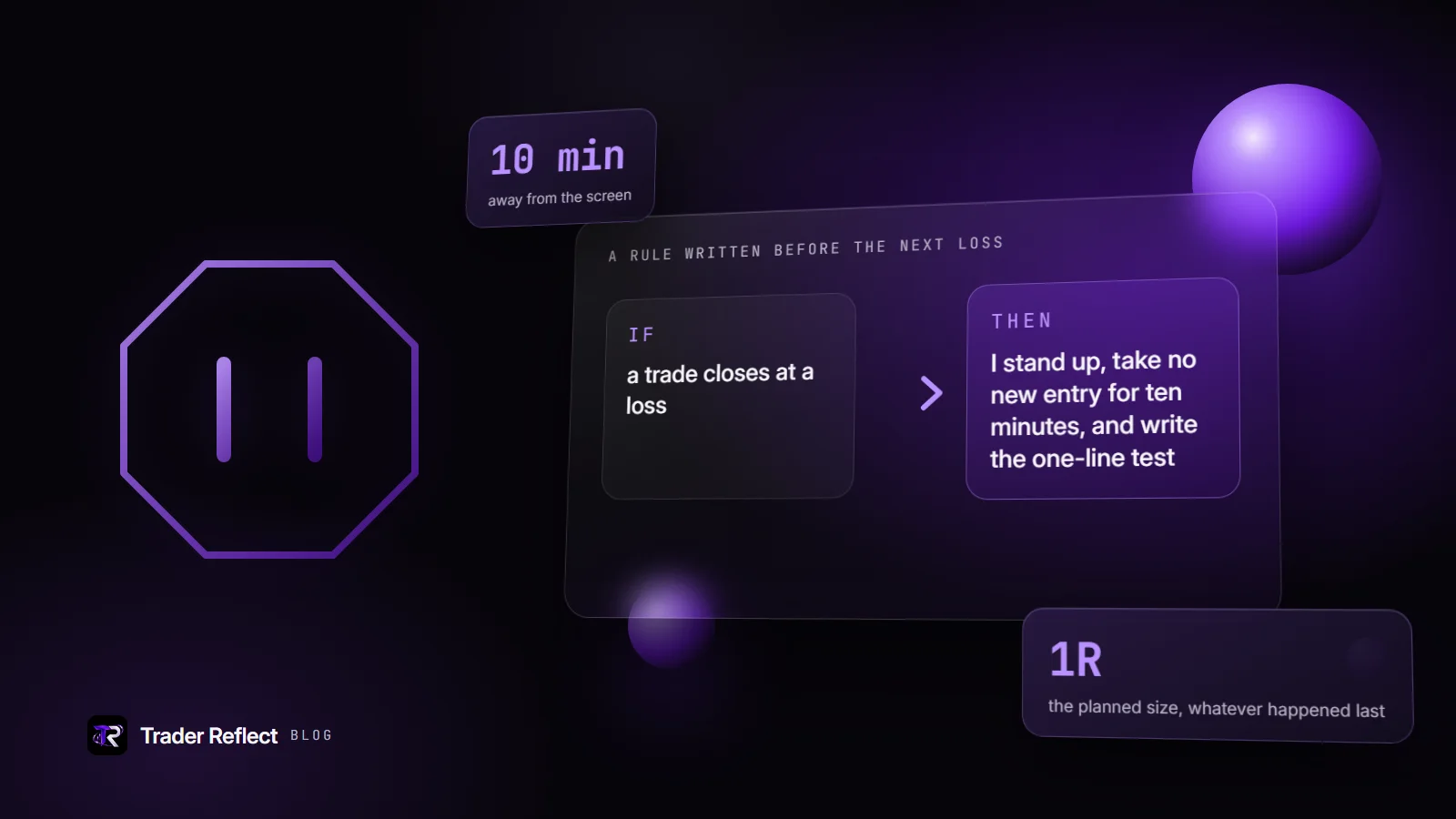
1. The cool-off. If a trade closes at a loss, you take no new entry for a fixed time, such as ten minutes, and you spend it away from the screen. Make it physical: stand up, leave the room, drink some water. Ten minutes is long enough for the first spike to fade and short enough to keep.
2. The one-line entry test. Before the next entry, write one line: which setup in my plan is this, and where is the invalidation? If you cannot write it in under a minute, you do not take the trade. It only forces the plan back into the decision.
3. The size lock. The size of the next trade is the planned size, whatever happened last. If your plan risks 1R, it is 1R. No exceptions after losses, and no "just this once" in a drawdown.
4. The stop-out limit. Set a maximum number of losing trades, or a maximum loss in R, after which the session ends. Decide the number while calm. When it triggers, you close the platform. This is the rule that protects the worst days from becoming the worst weeks.
Make the rules concrete
A rule you can negotiate with will be negotiated with. Strengthen each one:
- State the number, not the intention: ten minutes, not a while.
- Pick a physical action, not a mental one: close the platform, not remind myself.
- Decide in advance what counts as a breach and log breaches without commentary.
An example of a full if-then plan: if a trade closes at a loss, then I stand up, leave the desk for ten minutes, and write the one-line entry test before any new order.
Check whether it works
The rule is a hypothesis. To test it, your journal needs three things per trade: the time of entry, the risk taken in R and whether the previous trade lost. With them you can compute, for trades entered within a short window of a loss, the average size and the average result in R, and compare both with the rest of your record. After a few weeks of the new rule, repeat the calculation. If the fast re-entries have become rarer and their size has fallen to the planned amount, the rule is working. If not, look at why: was the cool-off too short, did you skip the one-line test, or is the trigger something other than losses?
Be careful with samples. A dozen fast re-entries is too few to say that they are worse than your other trades, and a few large losses can dominate the average. Count how many trades each figure rests on. The glossary entry on sample size explains why this matters, and why your win rate lies shows why average R is the number to watch.
When it keeps happening
If you keep breaking the rules, do not make them harsher. Check three things first. Is the risk per trade so large that a single loss is painful? Painful losses make the urge stronger, and smaller size often reduces revenge trading without any other change. Are you trading while tired, rushed or distracted? Sleep and state matter more than most setups. And is the plan itself unclear? Vague plans leave room for the impulse.
A written note of how you felt before the re-entry also helps. If the same word keeps appearing, such as frustrated, that is a cue you can build the next rule around. The glossary entries on tilt and revenge trading describe the wider pattern. If trading is causing distress that you cannot manage, speaking to a qualified professional is a sensible step; a journal is no substitute.
Where Trader Reflect fits
Trader Reflect reads the trades in your Money Circle journal and measures the minutes between each loss and your next entry, then compares the result in R of the fast re-entries with the rest of your record, showing how many trades the finding rests on. If it finds the pattern, it turns it into an if-then plan like the one above and later checks whether you kept it. You can open Trader Reflect from your Money Circle Journal, and you can see what membership includes. For the chart side of the same problem, ChartViews has a useful piece on where a trade idea stops being valid, which gives the one-line entry test something concrete to point at.
Educational content, not financial advice. Trading involves risk of loss.