A loss stings, and the quickest way to make the sting stop is to win it back. Revenge trading is the name for that urge turning into an entry, usually within minutes, often at a larger size, and rarely with the care you give your planned trades. This post shows how to find it in your own trade record, what logging an emotion adds, and a simple rule that puts time between the loss and the next decision.
What revenge trading looks like in a record
From the inside, a revenge trade rarely feels like one. It feels like spotting a fresh setup, or getting back into an idea that was right but early. In a trade record, the signature is clearer. Three things tend to appear together:
- The entry comes soon after a losing trade closed, often within ten minutes.
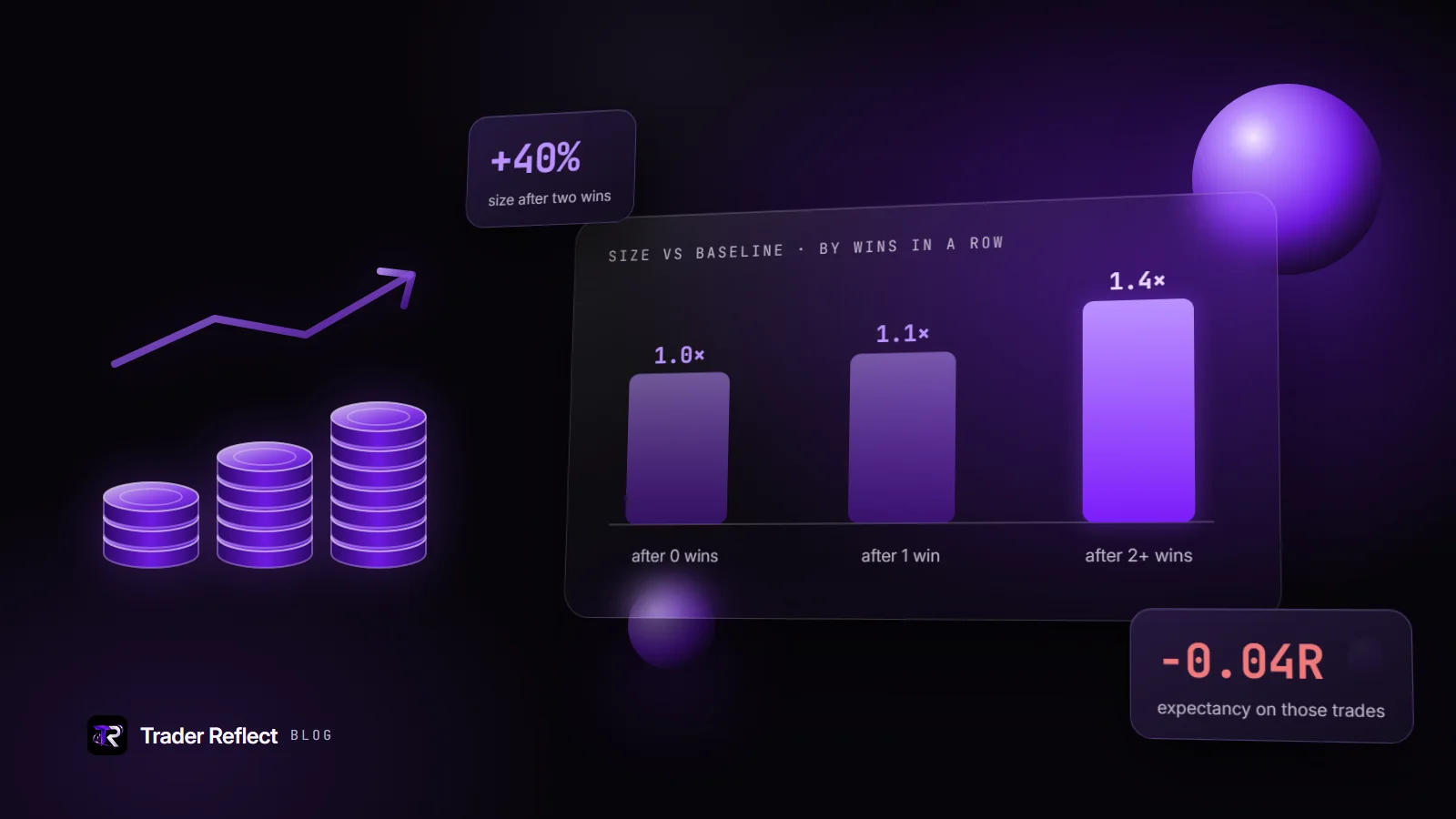
- The size is larger than your baseline, as if the next trade has to recover the last one.
- The expectancy in R on those trades is lower than on your other trades.
Any one of these alone can be innocent. A quick re-entry can be a legitimate second attempt with a fresh invalidation point. Together, they describe a trader who is trading the last result rather than the current chart.
Why a loss pulls you back in
Kahneman & Tversky (1979) found that losses loom larger than gains of the same size, a pattern now called loss aversion. Losing 1R feels worse than winning 1R feels good. The same paper reported that when every available choice involves a loss, people tend to become more willing to gamble, preferring a chance to avoid the loss over accepting it.
Both ideas fit the moment after a losing trade. The loss is painful, the account sits below where it was an hour ago, and a quick trade offers a chance to undo it. Kahneman (2011) describes a fast, automatic mode of thinking that supplies an answer before slower deliberation has started. A revenge entry is often that fast answer, acted on.
These findings come from studies of choices in controlled settings, not from your trading. They do not show that you revenge trade. They explain why it is worth checking.
How to check your own record
You need entry and exit times for every trade, not just dates. If your journal does not capture them, the Money Circle guide on what to record in a trading journal covers the fields that make this check possible.
- List your trades in time order with entry time, exit time, amount risked and result.
- For each trade, find the most recent losing trade that closed before this entry, and work out the minutes between that close and this entry.
- Put each trade in one of three buckets: under 10 minutes, 10 to 60 minutes, or over 60 minutes. Trades with no earlier loss in the same session go in the over-60 bucket.
- For each bucket, record the number of trades, the average size compared with your baseline risk, and the expectancy. Expectancy here is the average R-multiple, where a trade's R-multiple is its result divided by the amount risked on it.
The over-60 bucket is your reference. It is the closest thing in your record to a trader who has had time to settle.
A worked example
Suppose a trader's own record holds 150 trades, with wins around +2R and losses around −1R.
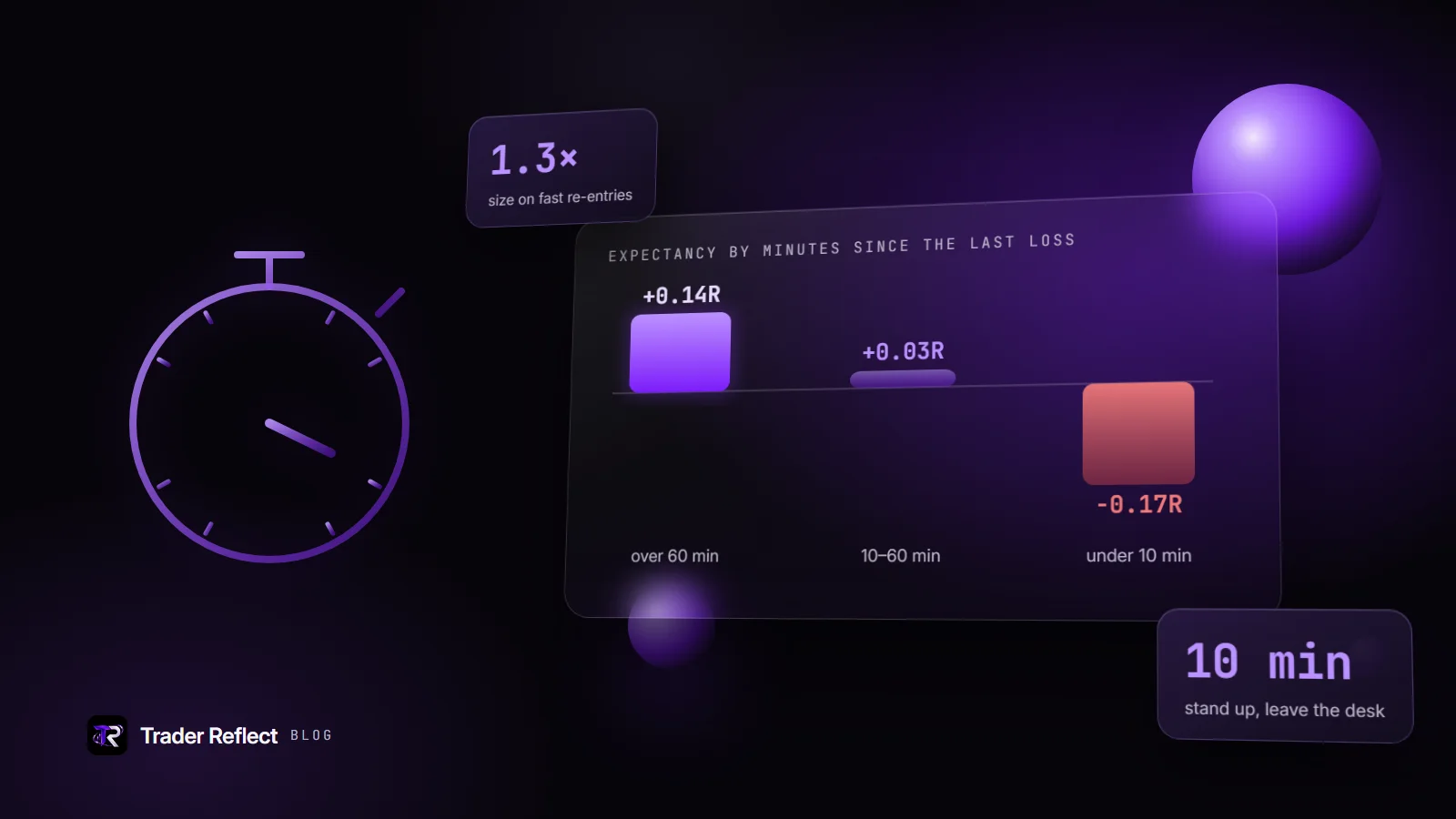
- Over 60 minutes (100 trades): average size 1.0. 38 wins at +2R = +76R, 62 losses at −1R = −62R. Net +14R, so expectancy is 14 ÷ 100 = +0.14R.
- 10 to 60 minutes (32 trades): average size 1.05. 11 wins at +2R = +22R, 21 losses at −1R = −21R. Net +1R, expectancy 1 ÷ 32 = +0.03R.
- Under 10 minutes (18 trades): average size 1.3. 5 wins at +2R = +10R, 13 losses at −1R = −13R. Net −3R, expectancy −3 ÷ 18 = −0.17R.
In baseline terms, the 18 fast re-entries lost about 3R × 1.3 = 3.9R. That is more than a quarter of the 14R the 100 patient trades earned.
Now the caution. Eighteen trades is a small sample. At a 38% win rate you would expect about 7 wins in 18 trades, so 5 is within ordinary variation, and the expectancy gap may shrink as more trades arrive. But two parts of the picture are not noise. The timing and the size are your own decisions, recorded exactly. If your fast re-entries are consistently 30% larger than your baseline, that is a habit, whatever the expectancy turns out to be.
What logging the emotion adds
Minutes since a loss is a stand-in. It catches the moment you are most likely to be upset, but not whether you actually were. Logging one emotion word at entry, such as calm, frustrated, rushed or bored, closes that gap.
Two lines of research suggest the act of naming helps. Lieberman et al. (2007) found that putting feelings into words reduced activity in the amygdala, a brain region involved in emotional responses, when people looked at emotional images. Pennebaker (1997) reviewed evidence that writing about emotional experiences can have measurable benefits. Neither was a trading study, so take them as a reason to try it, not as a guarantee.
In your record, the word lets you split the under-10 bucket. You might find that quick re-entries logged as calm look much like your baseline, while those logged as frustrated carry most of the damage. That tells you whether the problem is the clock or the state you are in, and it changes which rule you need. Name the feeling explains how to keep the logging to a few seconds per trade.
A rule: stand up and leave for ten minutes
A vague intention like "don't revenge trade" fails at the moment it matters, because in that moment the next trade does not feel like revenge. A specific if-then plan does better. Gollwitzer (1999) called these implementation intentions, and a meta-analysis of 94 studies by Gollwitzer & Sheeran (2006) found a medium-to-large effect on reaching goals (d ≈ 0.65), though none of those studies involved trading.
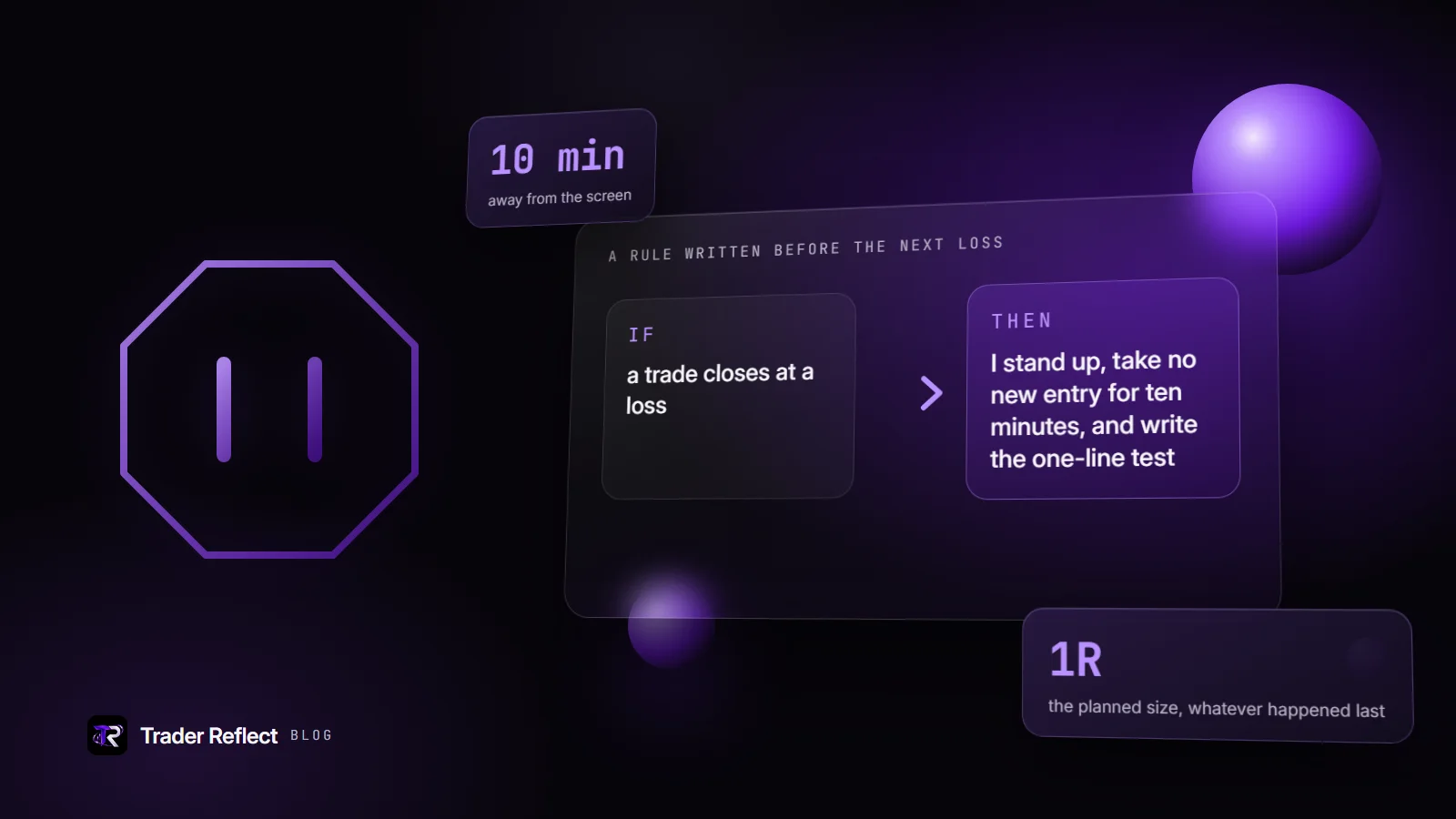
If I close a trade at a loss, then I stand up, leave the desk and set a ten-minute timer before I look at a chart again.
Leaving the desk matters more than the timer. A screen keeps offering setups, and sitting in front of it while you wait is not much of a pause. Ten minutes matches the bucket where the example record shows the problem. If your own record shows the 10-to-60 bucket is weak as well, lengthen the break. No study tells you the right number of minutes, so let your record set it.
When you come back, the next trade needs its own reason to exist. Write down where the idea stops being valid before you enter, as described in the ChartViews guide to trade invalidation, and take it at baseline size. If you cannot name that point, there is no trade. For more on building rules like this, see If-then plans for traders.
Let Trader Reflect check the timing
Trader Reflect reads your Money Circle journal and checks entries soon after a loss, the size you used and how results move with the emotion you logged, then names the one habit costing you most, with the numbers behind it and one if-then action. You can open Trader Reflect from your Money Circle Journal. It is included with paid Money Circle membership, and you can see what membership includes before deciding.
Educational content, not financial advice. Trading involves risk of loss.