Most trading resolutions are written in the language of character: be more patient, stop overtrading, respect the stop. They feel sincere on a Sunday evening and dissolve the first time the market moves quickly. Psychology research offers a plainer tool, the if-then plan, which ties one specific behaviour to one specific moment. This post explains why it tends to work better than a good intention, how to write one for a trading habit, and how to check in your own record whether you kept it.
Why "I will be more disciplined" fails
A good intention is a goal with no moment attached. "I will be more disciplined" does not tell you when discipline is needed or what it looks like. When it matters, straight after a loss or with a trade running in your favour, your attention is on the chart, not on a resolution written at the weekend. Kahneman (2011) describes the fast, automatic mode of thinking that handles most decisions made under time pressure. A vague goal gives that mode nothing to act on.
There is a second problem. A general intention leaves room to negotiate. "Disciplined" can mean taking the trade or skipping it, depending on how you feel. Loss aversion, described by Kahneman & Tversky (1979), makes that negotiation lopsided: losses loom larger than equivalent gains, so when you are down on the day the pull to win it back is stronger than the pull of an abstract rule.
What the research says about implementation intentions
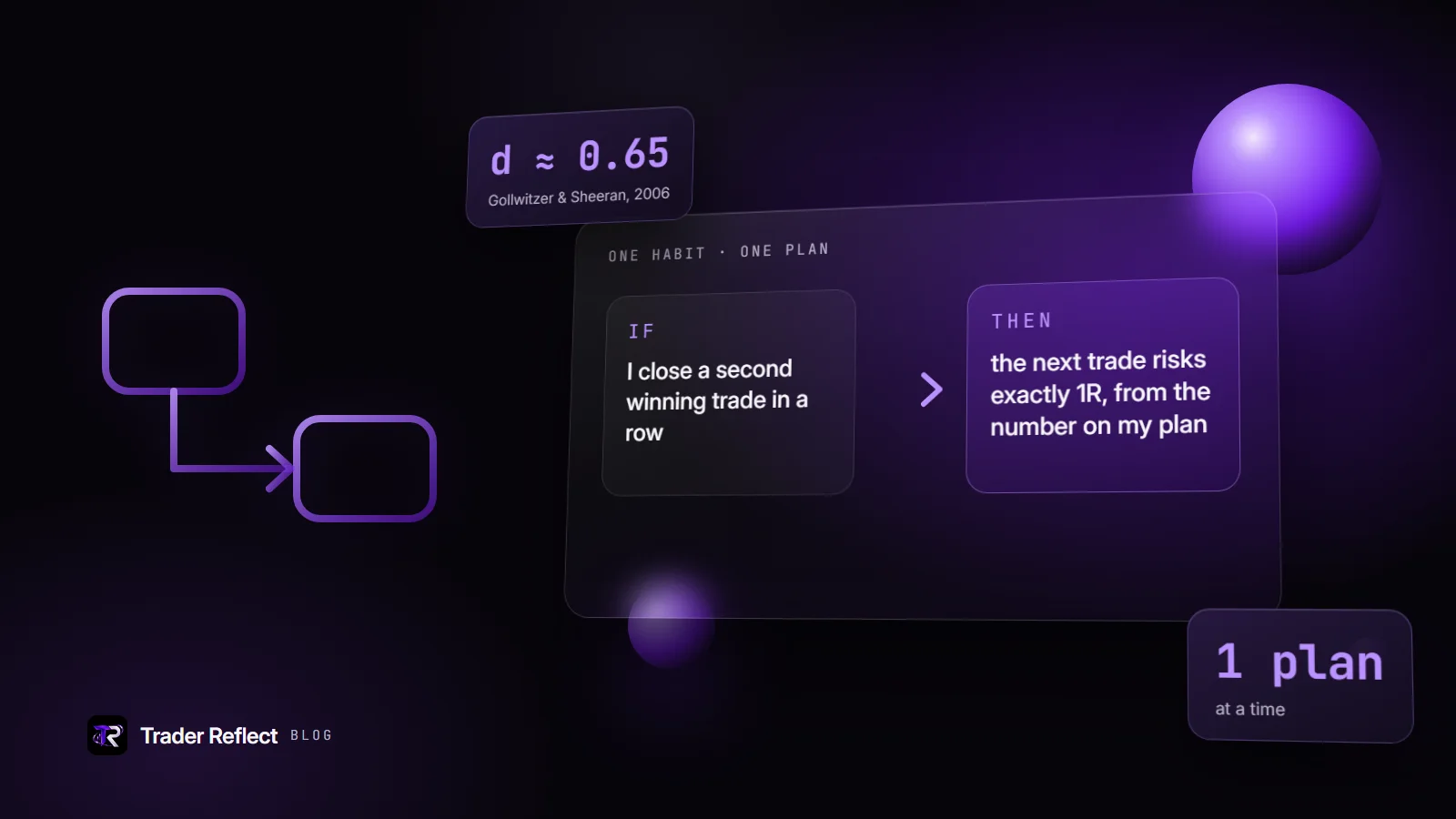
Gollwitzer (1999) called the alternative an implementation intention: a plan in the form "if situation X arises, then I will do Y". Instead of stating what you want, it states when, where and how you will act. The situation becomes a cue that triggers the behaviour with less deliberation, so the decision is made before the pressure arrives.
Gollwitzer & Sheeran (2006) pooled 94 studies in a meta-analysis and found a medium-to-large effect on goal attainment (d ≈ 0.65) compared with forming a goal intention alone. Be honest about its limits, though: the studies covered health, academic and everyday goals, not trading, and an average across many studies says nothing certain about any one person. It does suggest that the form of a plan matters, and that a specific if-then plan is a reasonable thing to test on yourself.
Anatomy of a good trading if-then plan
A plan has two halves, and both should be hard to argue with.
The cue. It should be something you notice without interpretation. Good cues are a clock time ("if it is 11:30"), a count ("if I close a second consecutive winner"), or an event that has already happened ("if I close a losing trade"). Weak cues require judgement: "if I feel tilted", "if the market looks choppy". By the time you are judging whether you are tilted, you usually are.
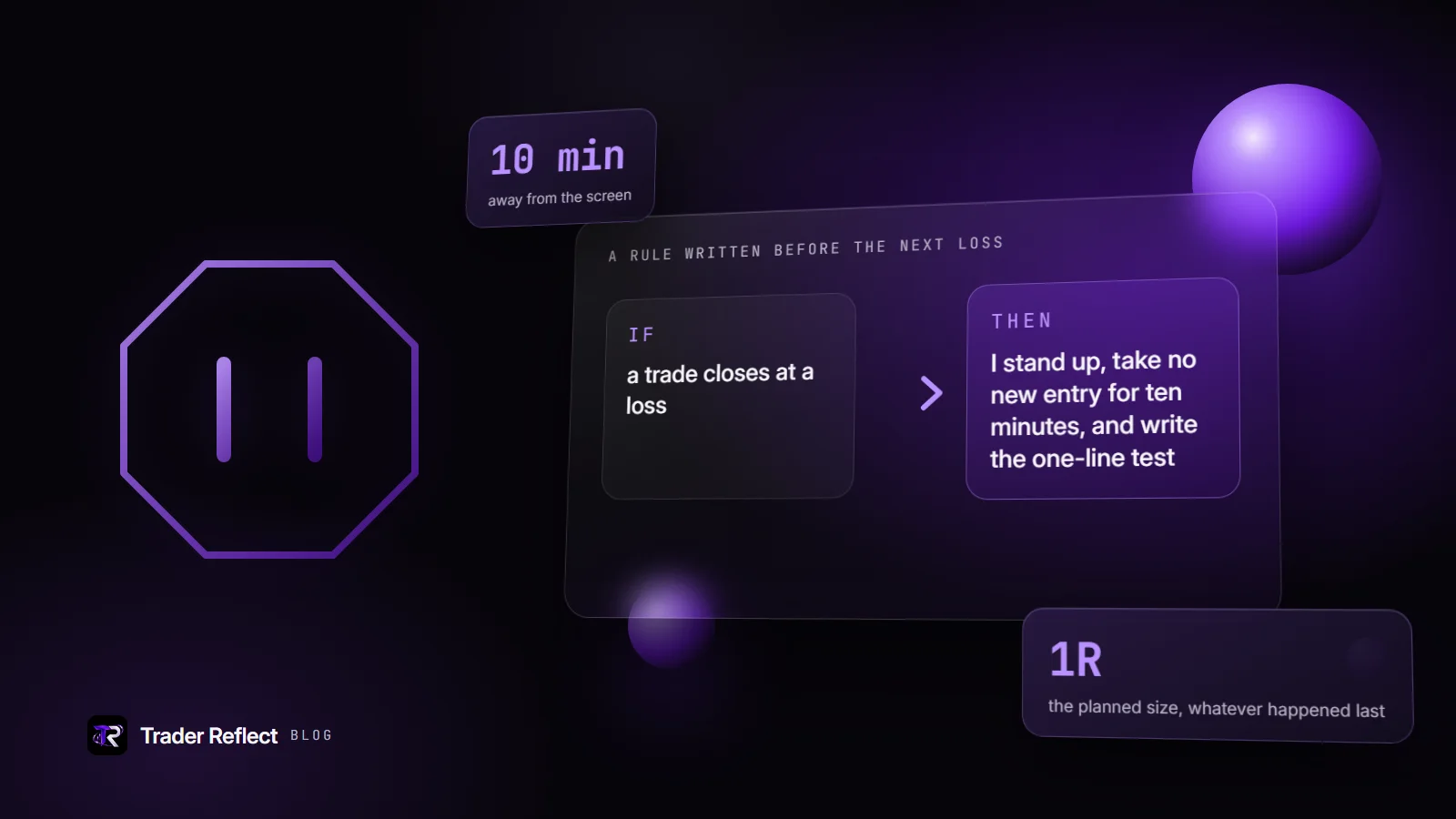
The behaviour. It should be one physical, unambiguous action. "Stand up and leave the desk for ten minutes" is a behaviour. "Calm down" is not. "Type the risk from my written plan into the order ticket before looking at the chart" is a behaviour. "Be careful with size" is not. If someone watching could not tell whether you did it, rewrite it.
- IfA cue you notice without interpreting
A clock time, a count, or something that has already happened — a second winner in a row, a losing trade closing.
- ThenOne physical, unambiguous action
Stand up and leave the desk. Type the risk from the written plan. Close the platform.
- CheckOccasions against kept
Count how often the cue came up and how often you did what the plan said, in your own record.
You probably already use one if-then plan. A pre-defined exit says: if price trades through the level that invalidates the idea, then the position is closed. ChartViews AI covers how to choose that level in trade invalidation: where an idea stops being valid. The plans below apply the same structure to your own behaviour rather than to the market.
Five worked examples
Each pairs a common, costly habit with one plan. Pick the one your own record points to, not the one that sounds most impressive.
- Re-entering straight after a loss. If I close a losing trade, then I write one line in my journal about why I took it before I open the next order ticket. The line takes about a minute, and the minute is the point. Revenge trading: how to spot it in your own record shows how to measure whether this pattern exists for you.
- Sizing up after a run of winners. If I close a second consecutive winner, then the next trade risks exactly my standard 1R, entered from the number written on my plan. Gilovich, Vallone & Tversky (1985) found that people see streaks in sequences close to random; Miller & Sanjurjo (2018) later showed a statistical bias in that analysis, so the "hot hand" is debated, but the safe point stands: people over-read short streaks. More in why traders size up after a winning streak.
- Trading past your best hours. If it is 11:30 local time, then I close the platform and log off. Positions already open keep their existing stop and target; there are no new entries. Take the time from your own results by hour, as in when your edge fades.
- Moving a stop further away. If I reach for the stop order on an open trade, then I may only move it towards the entry, never away. A stop widened from 1R to 2R doubles the possible loss on a trade that has already shown it might be wrong. Shefrin & Statman (1985) described this tendency to ride losers too long as part of the disposition effect.
- Cutting winners early. If a trade reaches +1R, then I take my hand off the mouse and set a five-minute timer before touching the position. Odean (1998) found that individual investors realised gains more readily than losses; this plan targets the first half of that pattern.
Why one plan at a time
It is tempting to adopt all five. Resist it. Each plan needs your attention at the moment its cue appears, and attention is what runs short when a session is going badly. Five plans means five cues to watch, and the likely result is that you keep none reliably and cannot tell which helped.
One plan also keeps the outcome readable. Change one behaviour across twenty or thirty occasions and, if results move, you have a reasonable guess why. Change five and you have a story. Choose the habit your own record shows is most expensive, run one plan until it is close to automatic or clearly not working, then move on. Expectancy in R explains how to put a cost on a habit so you can choose.
How to check whether you kept it
A plan you never check becomes another good intention. The check uses two counts from your own record:
- Occasions: how many times the cue happened. For plan 2, every trade that came straight after a second consecutive winner.
- Kept: how many of those times you did the behaviour. For plan 2, how many of those trades risked exactly 1R.
Suppose that over a month you had 12 occasions and kept the plan 9 times. That is a keep rate of 9 ÷ 12 = 75%. The 3 misses are the interesting part: what time was it, what had just happened, what did you note about how you felt?
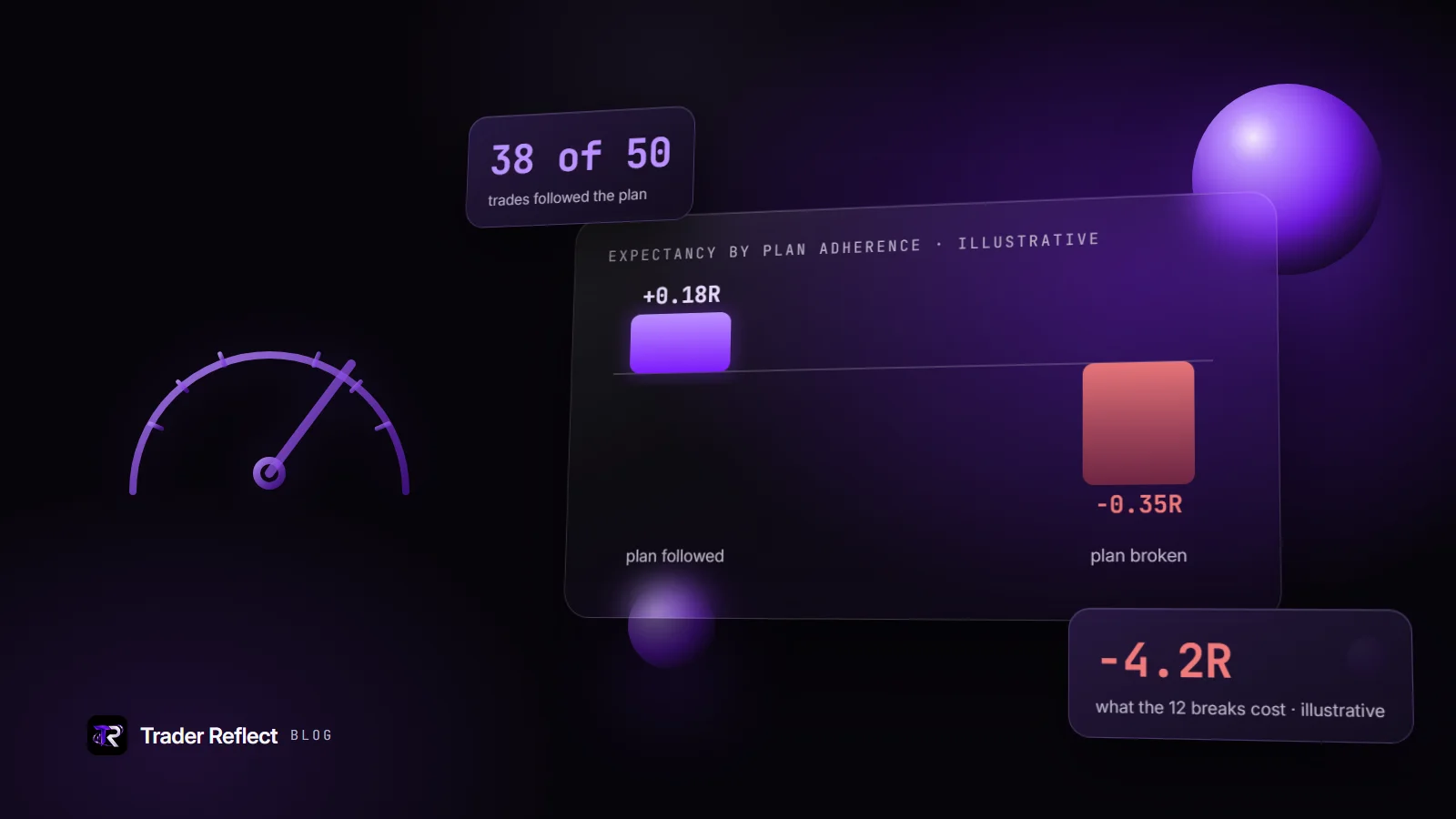
Then compare outcomes. Say the 9 kept trades totalled +1.8R, an average of +0.2R each, and the 3 missed trades, taken at double size, totalled −4.2R, an average of −1.4R each. Had those three trades matched the kept average, they would have added 3 × 0.2 = +0.6R. Instead they returned −4.2R, so missing the plan cost 0.6 − (−4.2) = 4.8R. Twelve occasions is a small sample, so treat that as a reason to keep going, not as proof.
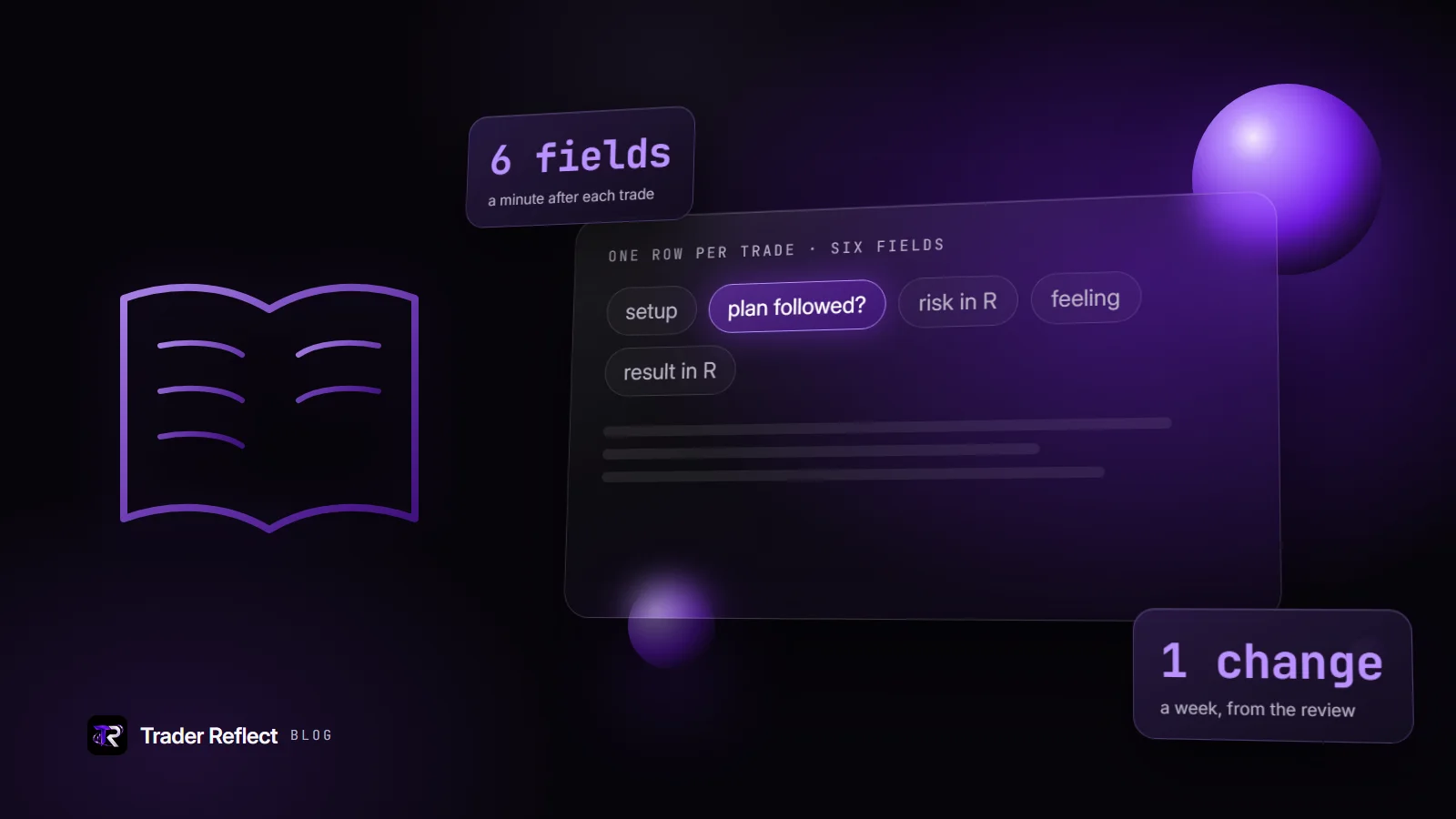
This only works if your journal records what the cue depends on: entry time, risk in R, result, and a note on what came before. Money Circle's guide to what to record in a trading journal covers the fields.
Trader Reflect reads your Money Circle journal, names the one habit costing you most with the numbers behind it, and gives you one if-then action to try, so the plan you start with comes from your own record rather than a guess. You can open Trader Reflect from your Money Circle Journal; it is included with paid Money Circle membership, and you can see what membership includes.
Educational content, not financial advice. Trading involves risk of loss.