A pre-market routine is a short, repeatable sequence you run before you place the first trade of a session. It does not predict anything. Its job is to make the first decision of the day a planned one: to check your state, set your limits and decide in advance what you will and will not do. This post describes what a useful routine contains, how to keep it short enough to survive a busy morning, and how to tell after a few weeks whether it is doing anything.
What a routine is for
Most of the costly habits in a trading record start from an unplanned moment: an entry because something moved, a size chosen on impulse, a session that ran on because nothing told it to stop. A routine puts a checkpoint in front of the session, when you are calm and the market has not yet asked anything of you.
Two things are worth being modest about. A routine does not make a good setup out of a poor one, and it does not remove the risk of loss. And more steps are not better: a routine that takes forty minutes is one you will skip on the morning you most need it. The glossary entry on the pre-market routine describes the idea in a sentence; this post is about making one you will actually run.
- StateA one-word feeling and a rule for a bad state
Before any chart.
- PlanThe calendar, the setups you trade and your limits
The same numbers every day, read rather than recalculated.
- FocusOne behaviour to watch, from last week's review
Closed at the end of the session with a two-minute check.
The five parts
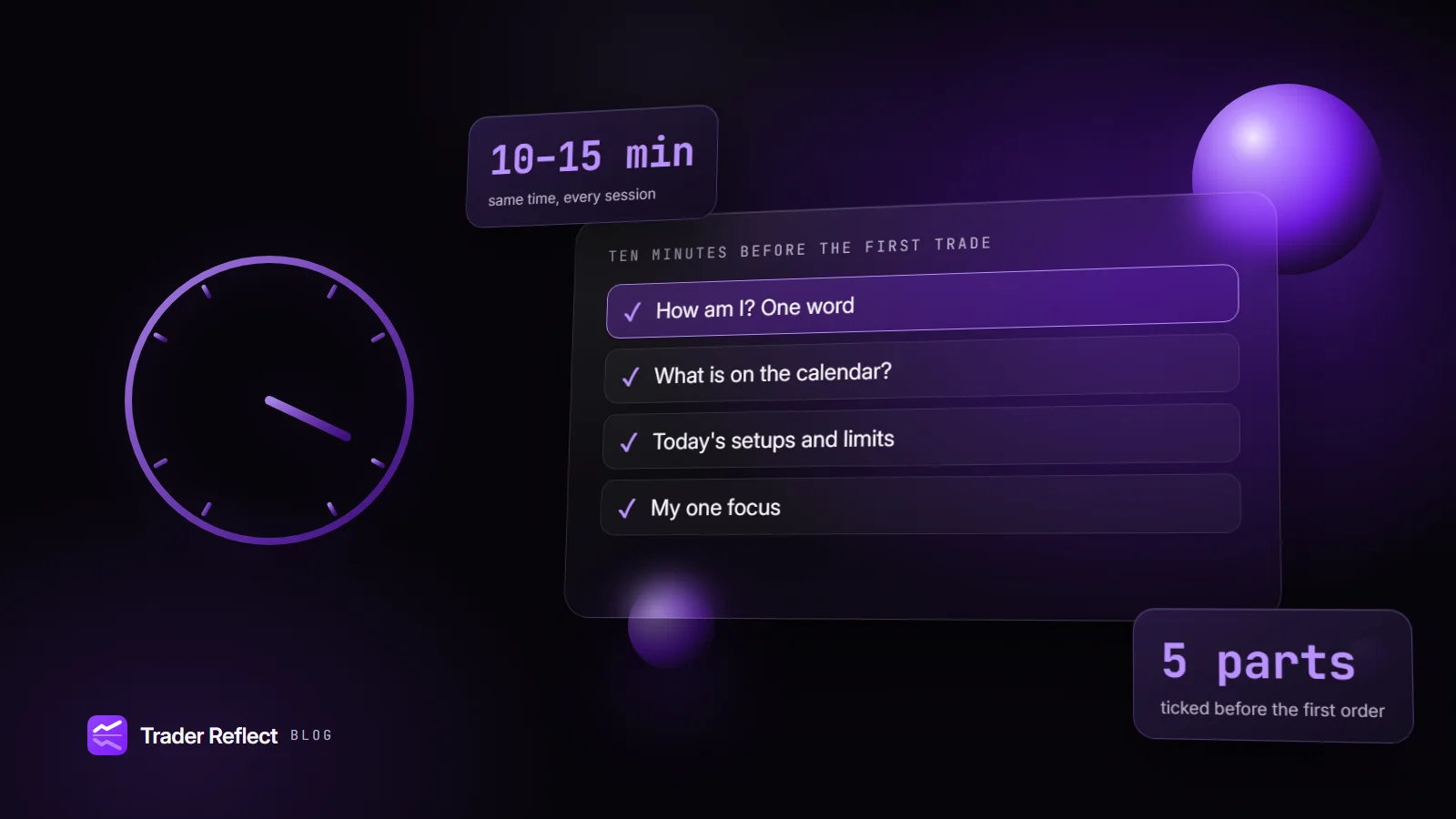
A routine that fits in ten to fifteen minutes can have five parts. Each answers one question.
1. How am I? Before looking at any chart, check your own state. Sleep, hunger, stress outside trading, how you left the last session. Choose a one-word feeling from a fixed list and write it down; the post on naming the feeling explains why a single word helps. Add a simple rule for bad states: if I am rated below a set level, then I trade at reduced size or not at all. Deciding that in advance is far easier than deciding it while a setup is flashing.
2. What is on the calendar? List scheduled events that could affect your instruments in your session window, and decide how you will treat them: sit out, reduce size, or trade as normal. The decision is the point, not the list. If you have a rule about news, this is where you apply it.
3. What is the plan for today? Name the setups you trade, written exactly as they appear in your trading plan. Note the levels or conditions you are watching, if you use them, and what would make you skip each one. Keep to the setups on your plan; a new idea that appears this morning goes on a list for the weekly review, not into today's session. The entry on the trading plan covers what a plan holds.
4. What are my limits? Write the numbers: the risk per trade in R, the maximum number of trades, the daily loss at which you stop, and the time you finish. If you trade under external rules such as a prop firm's, check your distance to those limits too; see reviewing trades against prop-firm rules. These are the same numbers every day, and that is the point: they are a commitment you read, not a calculation you redo.
5. What is my one focus? Pick one behaviour to watch today, taken from your last weekly review. It might be "no new entry for ten minutes after a loss" or "size from the calculator, every time". One item, not a list. This is the link between your reviews and your sessions, and it is the part most routines leave out.
Keep it short, make it physical
Put the routine on one page, on paper or in a note you open every day. Tick it off. A tick is a small signal to yourself that the checkpoint was passed, and an unticked routine is a visible gap that you can notice later in your record.
Run it at the same time every session, in the same place if you can. Habits attach to cues, and a fixed time is the easiest cue. If something interrupts it, run the shortened version: state, limits, focus. Three lines done every day beat five lines done on good days.
What to leave out
- Predictions. Writing down where you think price will go invites defending the prediction. Write conditions and responses instead: if this level breaks, then I consider this setup.
- Long reading. An hour of news is research, not a routine, and it belongs at another time.
- Anything you would not do on a bad morning. If a step needs good energy, it will be the first to go.
Ending the loop: the close-out
A routine has a mirror at the end of the session. Two minutes: tick whether you followed the plan on each trade, note your feeling and the time you stopped, and write one line on whether you kept today's focus. That is the data the weekly review uses; the post on reviewing your trades weekly shows how. Without the close-out, the pre-market routine is a ritual with no feedback.
Checking whether it works
After four to six weeks, look at your record in two groups: sessions where you ran the routine and sessions where you did not. Compare your plan-followed rate, your average risk against planned risk, and how often you broke your stop rules. Do this with the caution you would give any small sample: if you have only a handful of sessions in one group, say so, and keep collecting. The entry on sample size explains why.
If the routine days look no different, that is also useful. Either a step is not doing anything and can go, or the routine is not addressing the habit that actually costs you. Let the record decide, not the feeling that a routine ought to help.
Common ways routines fail
- Too long. Cut it until it takes less than fifteen minutes.
- A different routine each day. The benefit comes from repetition.
- A routine without limits. Thinking about the session is not the same as committing to the numbers.
- No link to the reviews. Your one focus should come from last week's finding, or it is decoration.
- Used as a substitute for a stop. A routine checks your state; it does not remove the need for a daily loss rule. Keep both.
Where Trader Reflect fits
If your trades live in the Money Circle journal, Trader Reflect names the habit that costs you most in your own record and gives you one thing to do about it, which is a good candidate for your daily focus, together with the number of trades behind the finding. The routine itself, and the decision to follow it, remain yours. You can open Trader Reflect from your Money Circle Journal and see what membership includes. For the journaling that feeds it, Money Circle's guide to what a trading journal should record is a useful companion.
Educational content, not financial advice. Trading involves risk of loss.