A single trade review tells you about one decision. A weekly review tells you about you. It is the point at which a pile of entries becomes a pattern, and it is where most traders either build a habit that pays off or quietly stop. This post lays out a weekly review that takes about thirty minutes, what to look at in what order, and how to avoid the two usual failures: reviewing too much once, and never again.
Why weekly, and why a fixed slot
Daily is too noisy. One day has a handful of trades and a lot of luck in it. Monthly is too slow: by the time you see a habit, it has been costing you for weeks. A week is long enough to hold a few dozen decisions for most active traders and short enough that you still remember the days.
Put it in the calendar at the same time every week, ideally when markets are closed, such as Saturday morning. A review that depends on motivation does not survive a bad week, and a bad week is exactly when you need it. Treat the slot like a meeting with the one person whose results you are responsible for.
Before you start: close the loop on the data
Spend the first five minutes making sure the record is complete. Missing entries bias everything that follows, because the trades people forget to log are rarely the good ones.
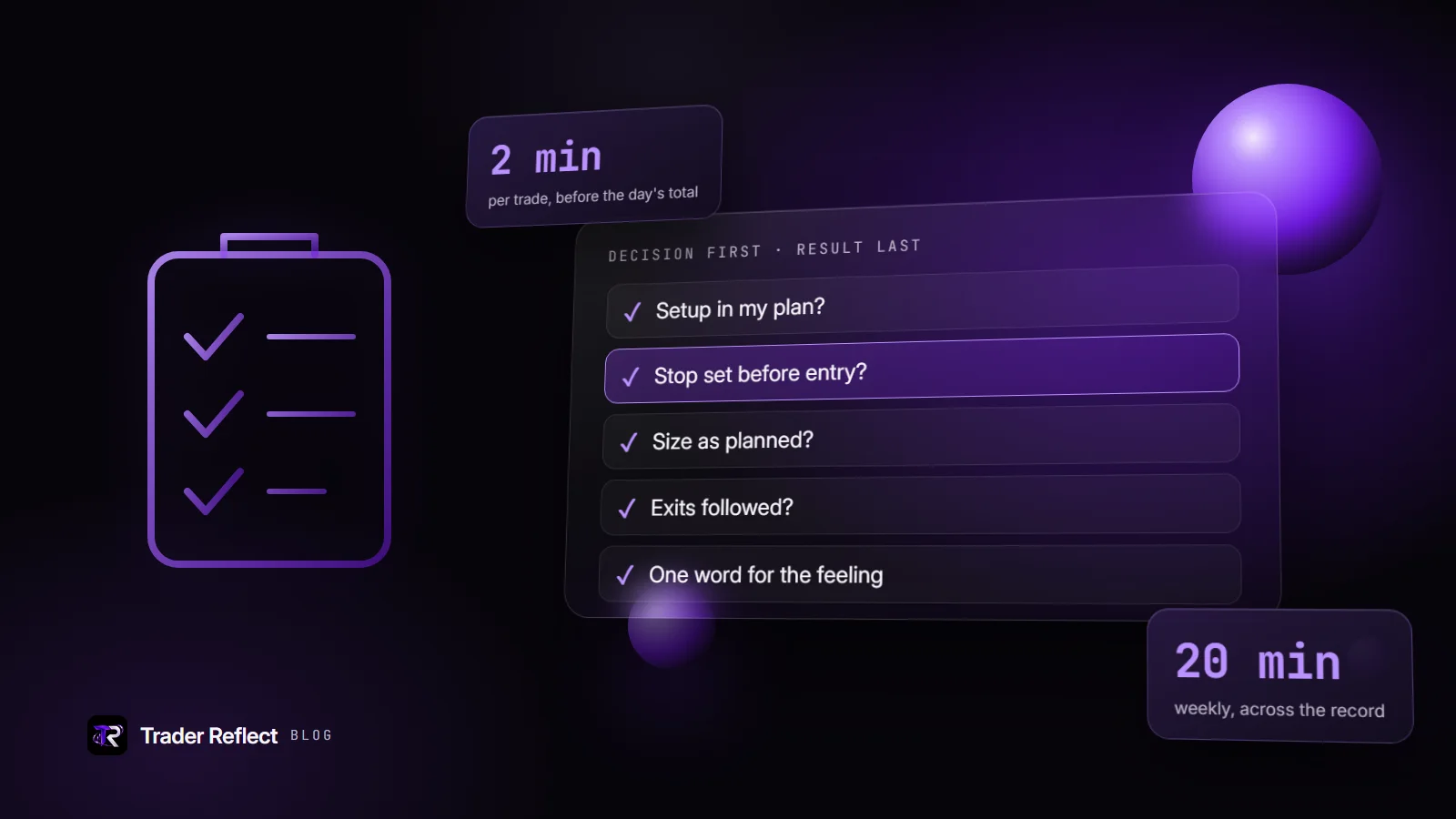
- Every trade from the week is in the journal, with its result in R.
- Each has a plan-followed mark: yes or no, decided from the plan, not from the outcome.
- Each has a one-word feeling from a fixed list, where you wrote one at the time.
If some are missing, fill them in from your platform history and mark them as late. Do not skip the step. A review of an incomplete week is a review of the version of the week you would like to remember.
- CountPlan-followed rate and the tagged breaks
Complete the record first, then count, before any profit and loss.
- CostWhat the breaks cost in R, and the state you logged
Say how many trades each figure rests on.
- DecideOne if-then rule for next week
Small enough to follow, written where you will see it.
The order of questions
The order matters. Start with what you controlled, end with what you did not.
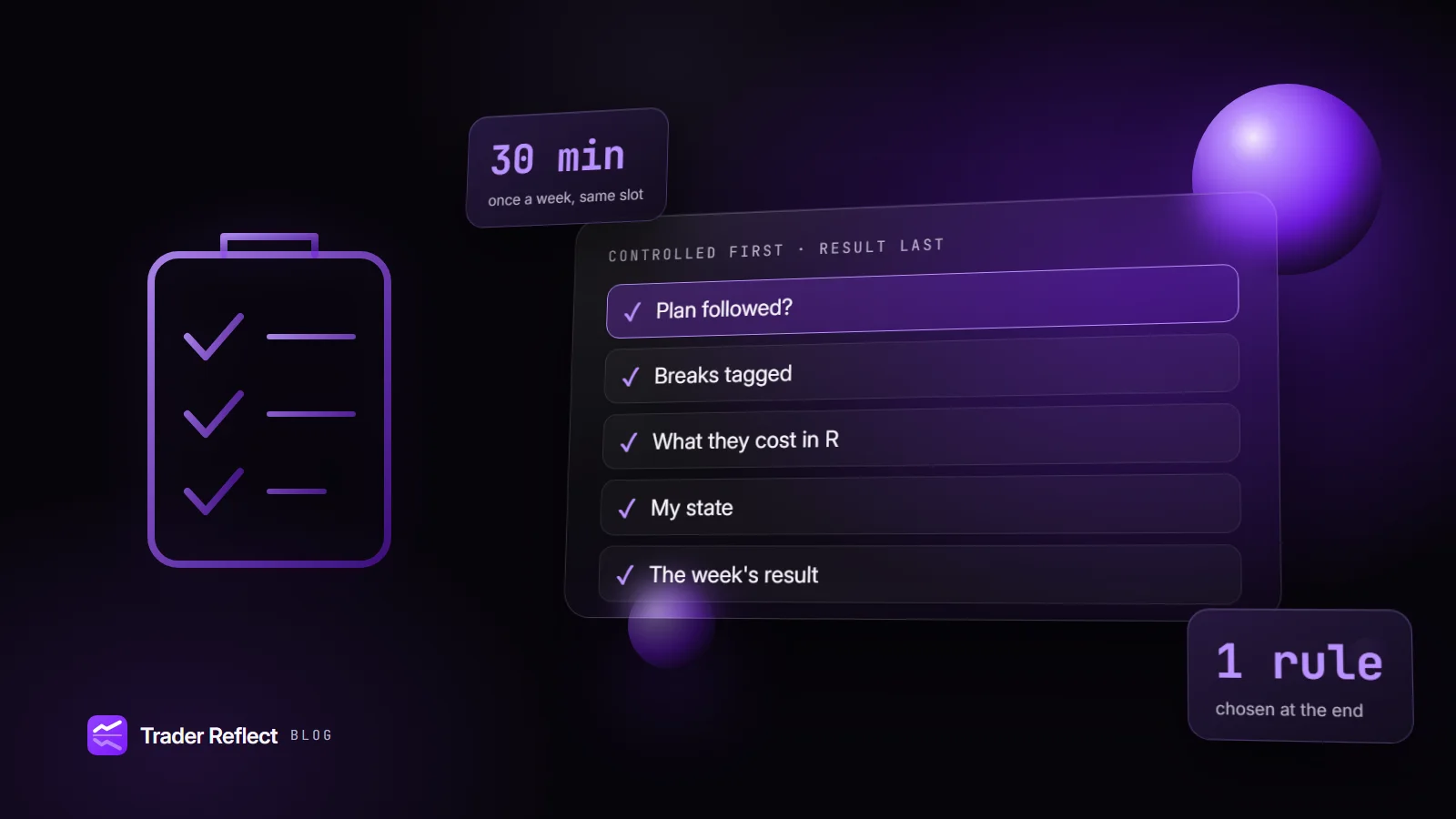
1. Did I follow the plan? Count the trades marked as plan followed and divide by the total. This is the one number to watch every week, because it is independent of the market. A good week with a poor plan-followed rate is luck, and a poor week with a high rate is variance. The post on measuring discipline goes into how to read it.
2. Where did I break the plan, and how? List the breaks and give each a short tag: moved stop, oversized, chased entry, skipped setup, traded outside hours. Count the tags. Usually one or two account for most of the breaks. That is the habit to work on, and it is rarely the one you would have guessed before counting.
3. What did the breaks cost? Add up the R on the trades that broke the plan, and compare it with the R on the ones that followed it. If the broken trades lost more per trade than the followed ones, you have a cost in R you can name. A named cost is much easier to act on than a general feeling of being undisciplined. Be careful with small groups: a handful of trades can mislead, so note how many trades each figure rests on.
4. What was my state when I broke it? Look at the feelings you logged next to the breaks. Do the breaks cluster on one word, such as impatient or frustrated? Do they cluster after a loss, late in a session, or on a particular day? You are not looking for a story, only for a repeated condition you could notice in advance.
5. Only then: how did the week go in R? Total R, win rate and so on. They belong at the end because they are the least informative part of the review, and putting them first colours how you read everything else.
Choose one change, in the form of an if-then
The review should end with a decision, and the decision should be small. One change, not five. Write it as an if-then rule so it can be acted on without thinking: if a trade closes at a loss, then I take no new entry for ten minutes. If the clock passes the end of my session window, then I close the platform. The research on if-then plans is about exactly this: a rule that names the situation in advance is easier to follow than an intention.
Write the rule where you will see it at the start of next week's sessions. Then the following review begins with one extra question: did I follow the rule, and did the break rate move?
Compare with last week, with a noise floor
It is tempting to read every change between two weeks as meaningful. Most are not. If your plan-followed rate went from seventy-five to seventy-eight percent, that is within the range you would expect from a normal week, not progress. Decide before you look what size of change you will count: a shift of ten points or more, or a change in a pattern that holds across several weeks. Everything below that is noise, and the honest summary is "no change", which is also a valid result.
Over a month, a trend across four reviews tells you more than any one of them. Keep the figures in a simple running list: plan-followed rate, the top break tag, the rule you chose, whether you kept it.
Common ways a weekly review goes wrong
- It becomes a performance review. If you open with the profit and loss, you will spend the half hour explaining it. Start with the plan-followed rate.
- It produces a list of fifteen resolutions. None will be followed. One rule, small enough to feel almost trivial.
- It is skipped after a bad week. This is the most expensive habit. Shorten it rather than skip it: the plan-followed count, the top break, the rule.
- It judges the person. The review is about decisions and conditions, not character. A break is information, not a verdict.
- It rests on too little data. If you took six trades, a pattern is not a pattern yet. Say so, and keep collecting.
A thirty-minute template
Five minutes to complete the record. Five to count plan-followed and tag the breaks. Ten to compare the groups in R and look at your logged states. Five to compare with last week. Five to write the one rule and put it where you will see it. When the habit holds, you can add things; until then, resist.
Where Trader Reflect fits
If you keep your trades in the Money Circle journal, Trader Reflect does the counting for the weekly step: it sets this week against last on behaviour, such as plan adherence and size after wins, reports only the differences that clear a noise floor, and names the habit costing you most with the number of trades behind it. The judgement and the one rule are still yours. You can open Trader Reflect from your Money Circle Journal and see what membership includes. For what to put in each entry in the first place, Money Circle's guide to what a trading journal should record is a good companion. The glossary has short entries on the post-trade review and on mistake tagging.
Educational content, not financial advice. Trading involves risk of loss.