If you trade a prop firm evaluation, your results are judged by someone else's rules as well as your own. A strategy can be profitable and still fail a challenge because of how a loss was measured, how many days you traded, or how close you ran to a limit. This post is about reviewing your trades against those rules: what the typical rules measure, how to build a short rule-aware review, and how to find the habits that put an account at risk before a limit does.
Rules differ between firms and change over time, so nothing here is a statement about any particular programme. Read the current rules of the one you trade, in full, and use this as a method for checking your record against them.
The rules that most often decide an evaluation
Most evaluations use some combination of the following. The names and the exact definitions vary, which is why you read your own.
- A daily loss limit. A maximum loss allowed in one day, measured against a starting balance or equity for that day. The detail that matters most is how it is measured: whether open positions count, whether it is based on balance or equity, and when the day resets.
- A maximum overall drawdown. A limit on how far the account can fall from a starting value or from a high-water mark. The two versions behave very differently: a trailing limit rises as the account rises, which reduces the room you have after a good run. The glossary entry on drawdown covers the basics.
- A profit target. A gain required to pass, sometimes over several phases.
- Minimum trading days. A required number of days with at least one trade, which can conflict with a plan that sits out most days.
- Consistency or concentration rules. Some programmes limit how much of the total profit can come from a single day or trade.
- Restrictions on timing and instruments. For example, around scheduled news, over weekends, or on certain products.
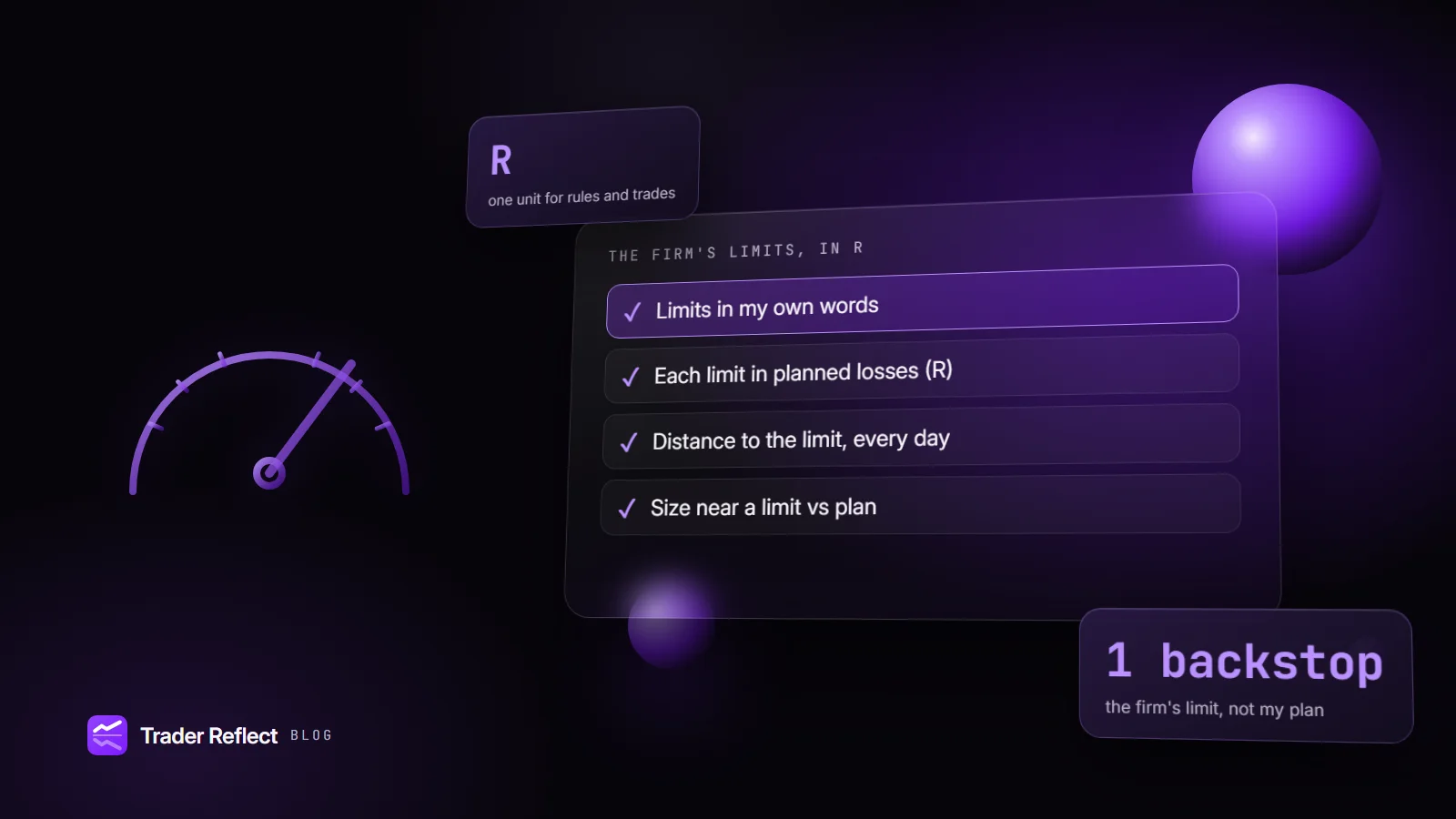
The first review step is to write these down in your own words, with the exact numbers and definitions from the document, in one place next to your plan. If you cannot state how your daily limit is measured, you cannot know how close you were to it.
- WriteThe firm's limits in your own words, with its definitions
Read the current rules in full; they differ and they change.
- ConvertEach limit into planned losses in R
How many full-risk losses fit in a day, and in the drawdown.
- MeasureHow close each day came, and what you did near a limit
Compare size and plan adherence on near-miss days.
Convert the limits into R
Limits are in money or percent, and your trades are in R. Connect the two once, so that the review can speak one language.
If your planned risk per trade is a fixed amount, divide the daily loss limit by it. That tells you how many full-risk losses fit inside a day before you are out. Do the same for the overall drawdown. If a limit allows, say, five planned losses in a day and your plan stops you after two, you have a margin, and that margin is a design choice you made on purpose. If the limit allows three and your plan allows five, the plan and the rules disagree, and the rules will win.
This conversion is simple arithmetic and it is often the most useful single thing a trader does with a rule set. It makes a hidden assumption visible: how many things have to go wrong before the account is gone.
What to look at in the record
With the rules in R, go through your recent trades, ideally the whole evaluation so far, and ask these questions in order.
1. How close did I run to each limit? For each day, compute the worst point of the day against the daily limit, as a share of that limit. Then look at the highest figures. A day that reached most of the limit is a near miss, even if you recovered. Near misses are information: what did those days have in common?
2. Did I take more risk as I got closer? Some traders shrink their size near a limit, which is sensible. Others raise it to get back to even or to hurry toward the target. Compare actual risk with planned risk on trades taken when you were close to a limit and on trades taken when you were not. The post on checking position size and risk per trade shows the check.
3. Did I follow the plan on the days that mattered? Compare your plan-followed rate on near-miss days with your overall rate. A drop on those days is the pattern to name.
4. Were my losses clustered? Several losses in a short window raise the chance of a limit breach more than the same losses spread over days. Look at time since the last loss for the entries during the cluster. If they were quick re-entries, you are looking at the pattern covered in revenge trading in your own record.
5. Did the target pull my behaviour? Near the profit target or near a deadline, traders often stretch: larger size, lower-quality setups, or trading when they would normally sit out. Look at the last stretch before a target or a deadline separately from the rest.
6. Did I trade only because of a minimum-days rule? Trades taken only to tick a day off the count are, by definition, outside the plan. Mark them as such. If they are costly, a smaller size on those days or an adjusted plan is better than none.
Build the rule-aware checklist
Add two or three prop-specific lines to your normal review. For example, per trading day:
- Distance to the daily limit at the end of the day, in R.
- Distance to the overall drawdown, in R.
- Whether any trade that day was taken at a size above plan.
- Whether I stopped when my plan said to stop.
Per week, add: how many days I came within a fixed share of a limit, and what I changed because of it. This takes a few minutes and ties the evaluation's rules to your own process.
Write the stop rules before you need them
The most useful prop-specific rules are stops that sit well inside the firm's limits. A personal daily stop at a fraction of the firm's daily limit means the firm's rule is a backstop and not a plan. Decide the fraction while calm, write it down, and use an if-then form: if my losses today reach this many R, then I close the platform. The post on if-then plans explains why the form matters.
A personal rule also protects against the quiet problem with a trailing drawdown: after a good run the room shrinks, and the same size that was safe last week may be too large now. Recompute your planned risk against the current room, not the room at the start.
Keep the evaluation in proportion
An evaluation is a process with rules set by someone else, and passing it is a different thing from being a good trader. Fees, resets and rule changes are real costs, and nothing here guarantees a pass or any result. Treat the evaluation as a stress test of your own process. If the review shows that your habits are what bring you close to the limits, then the habits are the useful finding, whatever happens with the account. Money Circle's piece on what a prop firm challenge is and what you are buying is a sober companion to this one.
Where Trader Reflect fits
If you log your trades in the Money Circle journal, Trader Reflect reads that record for the behaviours that tend to put an account near a limit, such as size after wins, quick re-entries after a loss and late-session fades, and shows the number of trades behind each finding. It does not know your firm's rules; the conversion into R and the stop rules are yours to write. You can open Trader Reflect from your Money Circle Journal and see what membership includes. The glossary entries on overtrading and risk of ruin are short and relevant.
Educational content, not financial advice. Trading involves risk of loss.