Ask most traders what they want from the next month and the answer is a number: a profit target, a percentage, a payout. It is a natural goal, and it is the one thing you do not control. The market decides whether a month is profitable; you decide whether you followed your plan. This post compares outcome goals with process goals, explains why mixing them up quietly damages decisions, and shows how to write process goals that you can check in your own record, with a short worked example.
Two kinds of goal
An outcome goal names a result: "make a set amount this month", "reach a set balance", "pass the evaluation". Results depend on the market, on variance and on how many setups appear, so they can be missed even when you traded well, and met even when you traded badly.
A process goal names behaviour you control: "size every trade from the plan", "log every trade before the next entry", "stop when the daily limit is reached". You either did it or you did not, and you can check it from your own record. The glossary entry on process goals gives the short definition.
Neither kind is wrong. Outcome goals give direction and are often the reason you trade at all. The trouble starts when the outcome goal becomes the daily yardstick, because it is the wrong tool for judging a single day or week.
What happens when the outcome sets the pace
An outcome target turns a number into a deadline, and deadlines change behaviour in predictable ways:
- Behind target, risk creeps up. The target needs to be met, so size increases or standards loosen. The post on revenge trading in your own record shows the loss-side pattern.
- Ahead of target, caution turns into protecting. Setups get skipped because the day already "worked", or exits come too early.
- A good result from a bad process is rewarded. You hit the number by breaking a rule and learn to break it again.
- A bad result from a good process is punished. You abandon a sound plan after normal variance.
The last two are the quiet damage. They teach you the wrong lesson from the same record. The post on why your win rate lies covers the same trap in a different form: short runs of results look meaningful long before they are.
Writing process goals you can check
A useful process goal has four properties. It describes something you do, it can be counted, it comes from a problem in your own record, and it has a time frame. "Be more disciplined" fails all four. "Size from the plan on every trade this month" passes.
Good sources for goals are your own findings. If your weekly review shows entries within ten minutes of a loss do worse, the goal is "wait ten minutes after a loss". If the journal shows the stop moved on a third of your trades, the goal is "no stop moved after entry". The post on reviewing your trades weekly shows how to produce those findings.
A few examples of checkable process goals:
- Plan followed on every trade, logged as yes or no. See measuring discipline.
- Planned risk and actual risk match within a set tolerance on every trade.
- Journal entry written before the next trade.
- The pre-market routine ticked on every session day.
- Stop at the daily limit on every day it is reached.
Choose one or two for a month, not eight. A list of eight is a mood. Two are a habit under construction.
A worked example
The numbers below are illustrative, not real data.
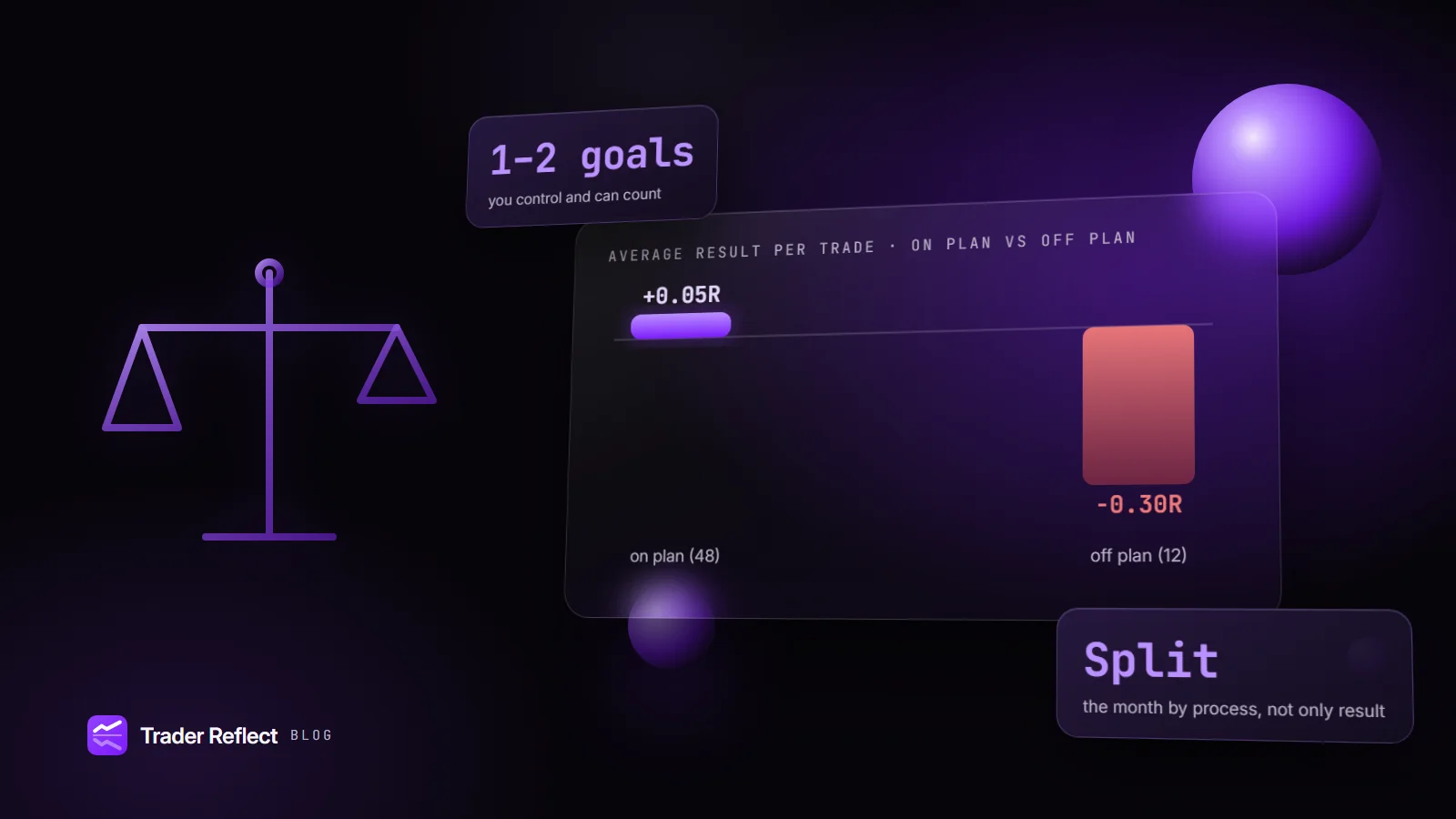
A trader sets an outcome goal for the month and, separately, a process goal: "plan followed on at least nine in ten trades". At the end of the month, the record shows 60 trades, 48 of them on plan and 12 off plan. The month's result is slightly negative.
An outcome-only reading says the month failed. A process reading looks at the split. On the 48 on-plan trades, the average was a small positive amount in R. On the 12 off-plan trades, the average was clearly negative. The month's loss came from the off-plan group, and the plan itself held up.
The process finding gives the next month a specific job: reduce the off-plan trades, not change the strategy. Without the split, the likely response would be to change a plan that was working.
Note the limits. Forty-eight and twelve are small groups, and a different month could look different. The entry on sample size explains why counts like these should be read as indications, and why the goal for next month is to gather more of the same evidence.
Keeping an outcome goal without letting it steer
You do not have to give up outcome goals. Keep one, but change how you use it:
- Look at it on a long horizon. Quarterly or yearly, not daily.
- Make it conditional on process. "If I follow my plan on nearly every trade for a quarter, I will review the results and decide whether to change anything."
- Separate it from risk. The target never changes the risk per trade. The size comes from the plan, always.
- Write what you will do when behind. The answer should be "the same plan", written in advance.
How to review a process goal
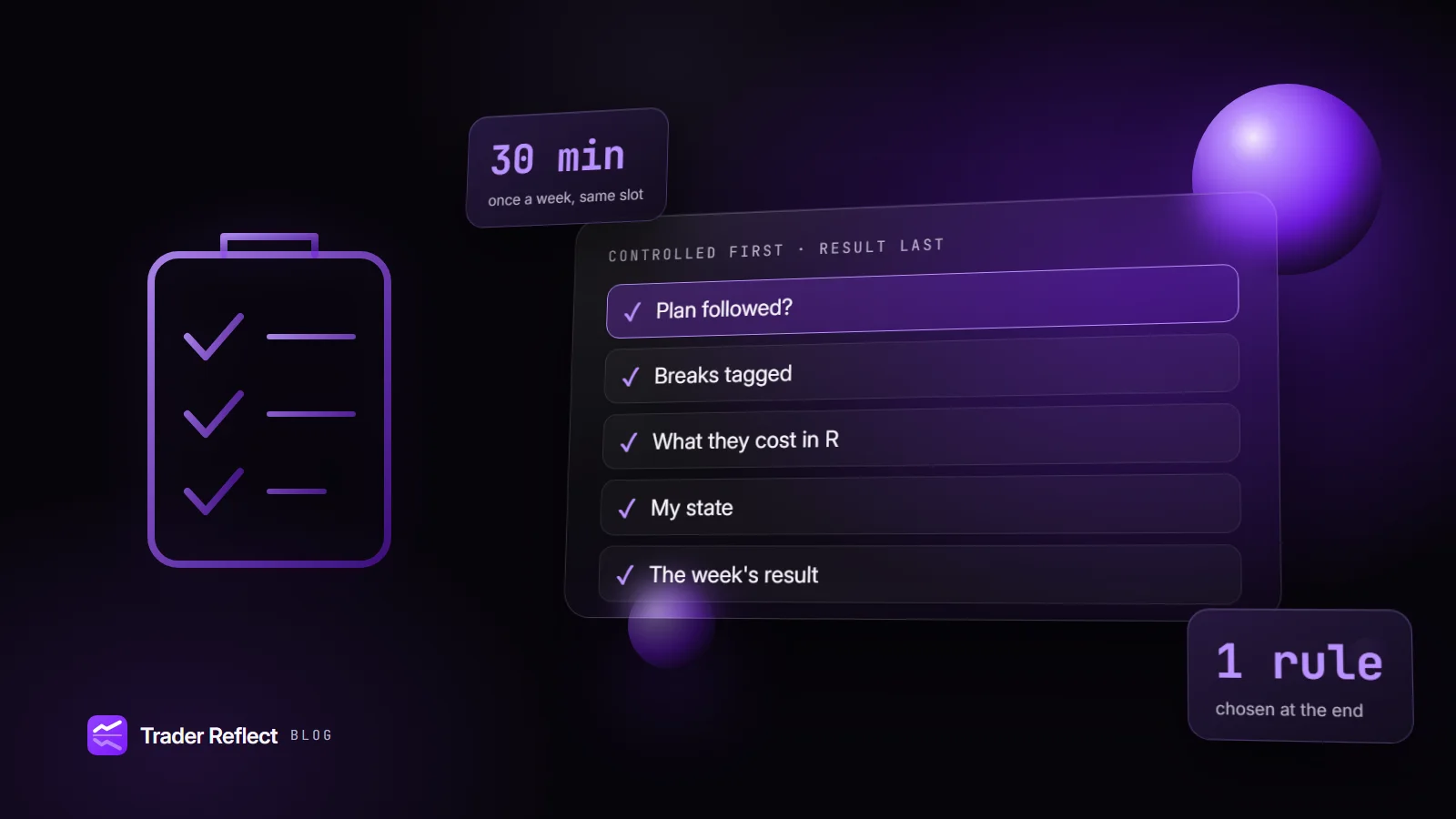
At the end of each week and month, ask:
- How many trades did the goal apply to, and how many followed it?
- What happened on the ones that did not? Is there a pattern in time, feeling or setup?
- Did following the goal cost anything in R, and did breaking it?
- Should the goal be tighter, looser or replaced?
Keep it honest and small. If you followed the goal on almost every trade for several weeks, retire it and pick the next habit from your record.
Common ways this goes wrong
- A process goal that is secretly an outcome goal. "Take only winning setups" cannot be checked.
- Too many goals. You will not remember them mid-session.
- Changing goals when results are bad. The point is consistency across good and bad stretches.
- Treating adherence as proof of an edge. Following a plan shows that you executed it, not that it works. Check the plan's results separately with expectancy.
- Ignoring the result entirely. A plan that loses over a large sample needs to change; the process is where you find out why.
Where Trader Reflect fits
Trader Reflect names the habit that costs you most in your own record, with the number of trades behind the finding, which is exactly the raw material for a process goal. What to do about it, and whether to follow it, stays your decision. You can open Trader Reflect from your Money Circle Journal and see what membership includes. For tracking your weekly numbers, Money Circle's guide to a weekly trading review routine is a useful companion.
Educational content, not financial advice. Trading involves risk of loss.