Tilt is the name traders borrow from poker for a state in which frustration or excitement has taken over the decisions. You are no longer executing a plan; you are reacting. It is not a character flaw and it is not rare. It is a predictable response to a loss, a missed move or an unexpected win, and the useful question is not how to avoid it but how to notice it sooner. This post describes what tilt looks like before it shows in the loss column, how to catch it in your own record, and how to write a short reset you can use mid-session.
What tilt is, and what it is not
The glossary defines tilt as emotion-driven trading that departs from your plan. Two things are worth separating from it.
First, tilt is a state, not a single trade. A bad trade made in a calm state is a plan or execution problem. A sequence of increasingly loose trades made while irritated is tilt. The distinction matters because the fixes differ: a plan problem needs a plan change, and tilt needs an interruption.
Second, tilt is not always negative emotion. Excitement after a big win can push size and trade count up just as frustration does. If you only look for anger, you will miss half of it. The post on sizing up after a winning streak covers the winning side, and revenge trading covers the most familiar losing-side form. Tilt is the wider state behind both.
The early signs
By the time a drawdown is visible, tilt has usually been running for a while. The earlier signs are behavioural and easy to write down:
- Speed. Entries come faster than your usual gap between trades.
- Size or risk drifts. The number you type is not the number on your plan.
- Stops change. A stop is moved, removed or set after entry instead of before.
- Setups loosen. Trades that you would have skipped an hour ago now seem fine.
- Physical cues. Tension, a clenched jaw, shallow breathing, standing up and sitting down, a need to look at the position constantly.
- Inner talk. Sentences that start with "I need to", "I should have" or "this time".
None of these proves tilt, and some of them happen on calm days. The value is in having a list you wrote while calm, so that when two or three appear together you have a rule to apply instead of a mood to argue with.
Finding it in your own record
You can look for tilt after the fact, and that helps you learn what yours looks like. Use only fields you already log: time of entry, planned risk, actual risk, whether the plan was followed, and the one-word feeling from your journal. The post on naming the feeling explains the vocabulary.
- StopNo new orders while you run it
Open positions keep their original stop.
- BodyStand up, leave the screen, breathe slowly
The step most people skip.
- NameOne word for the feeling, in the journal
Describing it moves you out of it.
- AskIs the next setup on the plan, with stop and size written down?
If not, pause for the time you wrote in advance.
Three questions give a first picture:
- Gaps. For each session, how long was the gap between a close and the next entry? Sort the gaps. Do the shortest gaps come after losses, and what was the result in R?
- Drift. On which trades did actual risk exceed planned risk, and what came just before them?
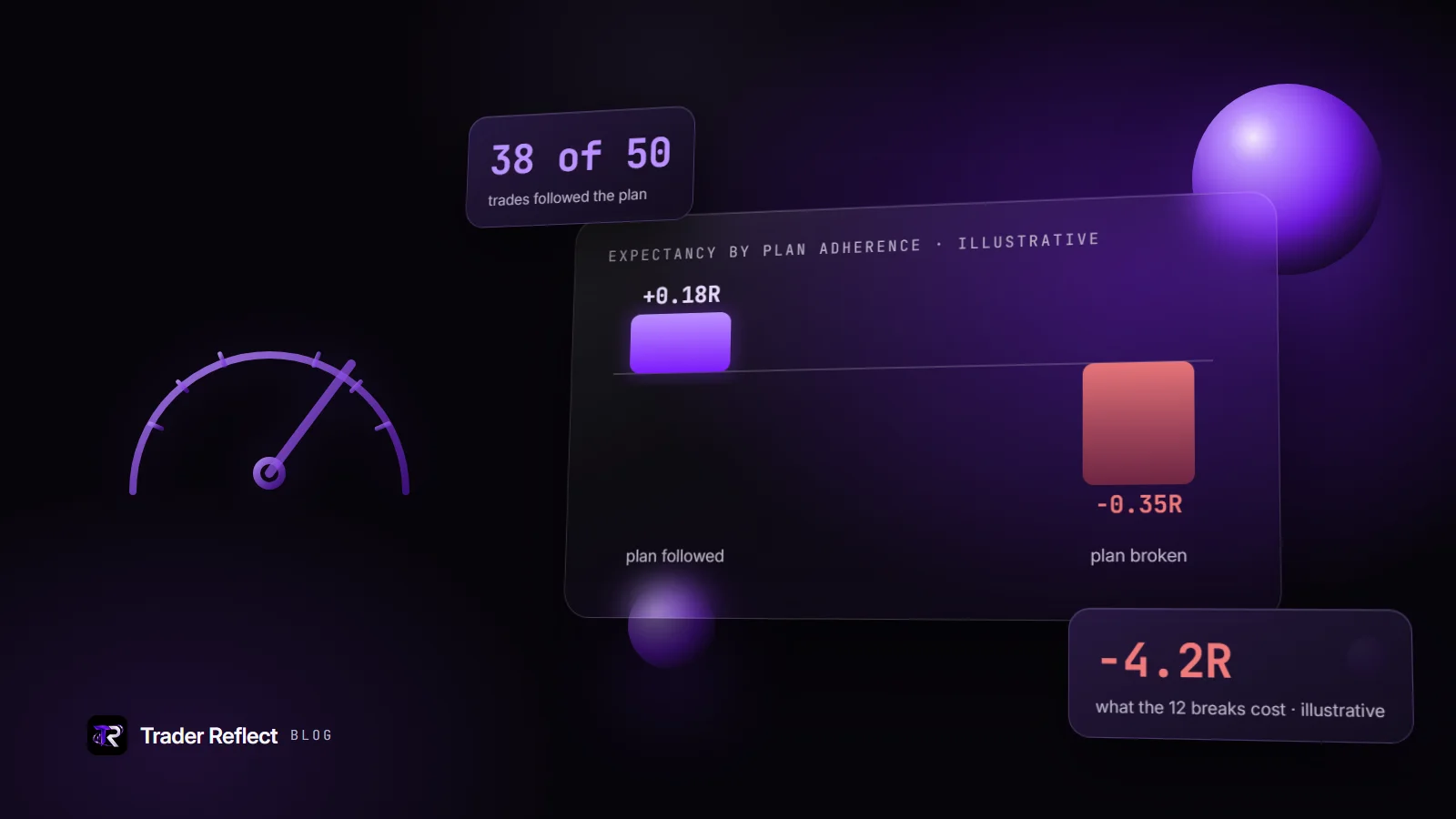
- Labels. Do trades labelled impatient, frustrated or euphoric show a different expectancy in R from calm ones? Treat this as an indication only. The entry on sample size explains why a handful of trades per label proves little.
Write down what you find as a sentence about yourself, for example: "my entries within ten minutes of a loss are larger and loosely planned". That sentence is the raw material for a rule.
A reset you can run in two minutes
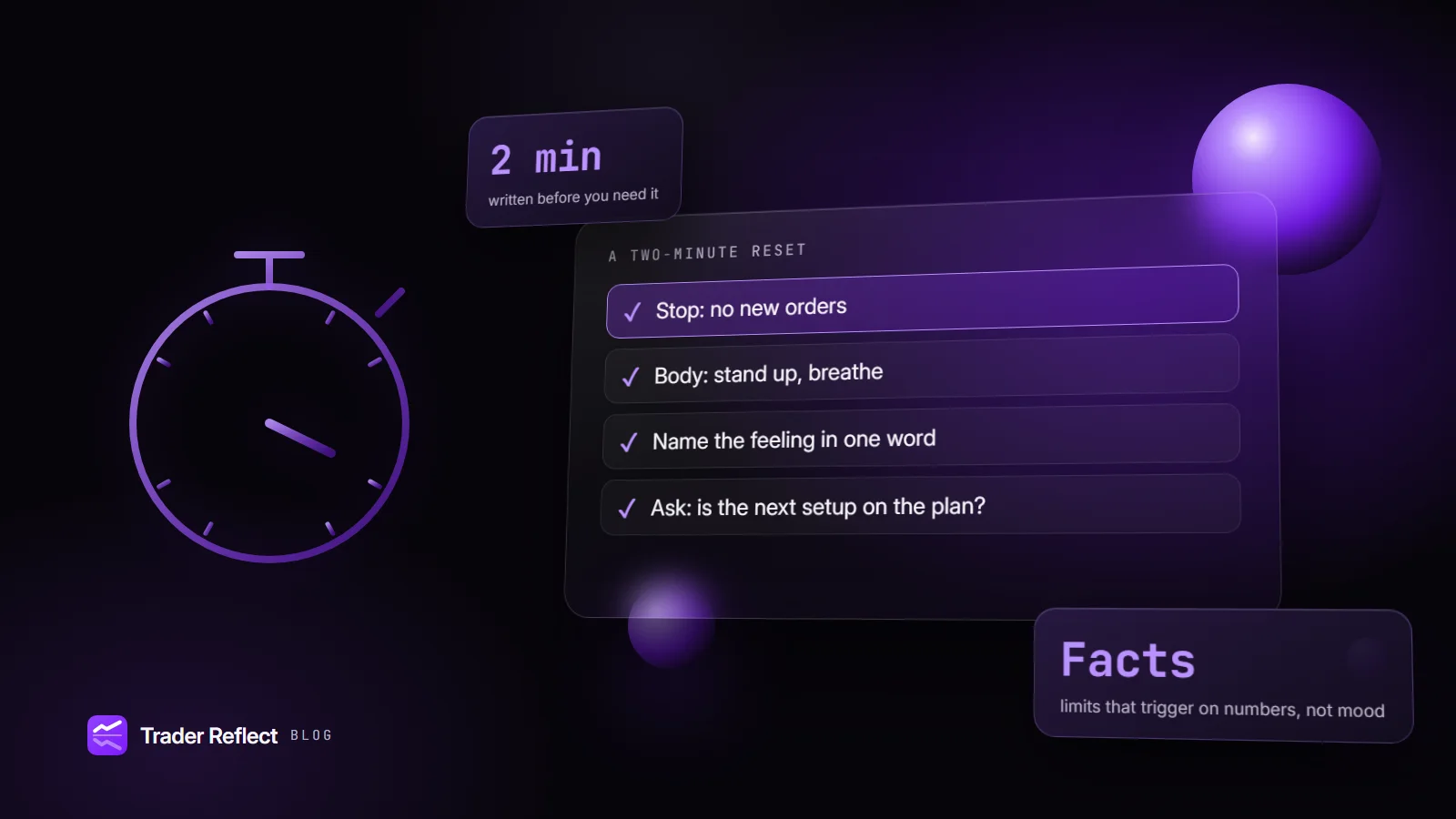
A reset interrupts the state. It does not need to fix anything; it only needs to create a gap in which a planned decision can happen. A simple version has four steps, and you write it before you need it:
- Stop and flatten the decision. No new orders while you run the reset. Existing positions keep their original stop.
- Change your body. Stand up, leave the screen, drink some water, breathe slowly for a minute. This sounds trivial and is the part most people skip.
- Name the feeling in one word and write it in the journal. Naming does not remove the feeling, but it moves you from inside it to describing it.
- Ask the plan question. "Is the next setup on my plan, with a stop and size I can write down before entry?" If the answer is no, or if you cannot answer calmly, the session is over or paused for a set time.
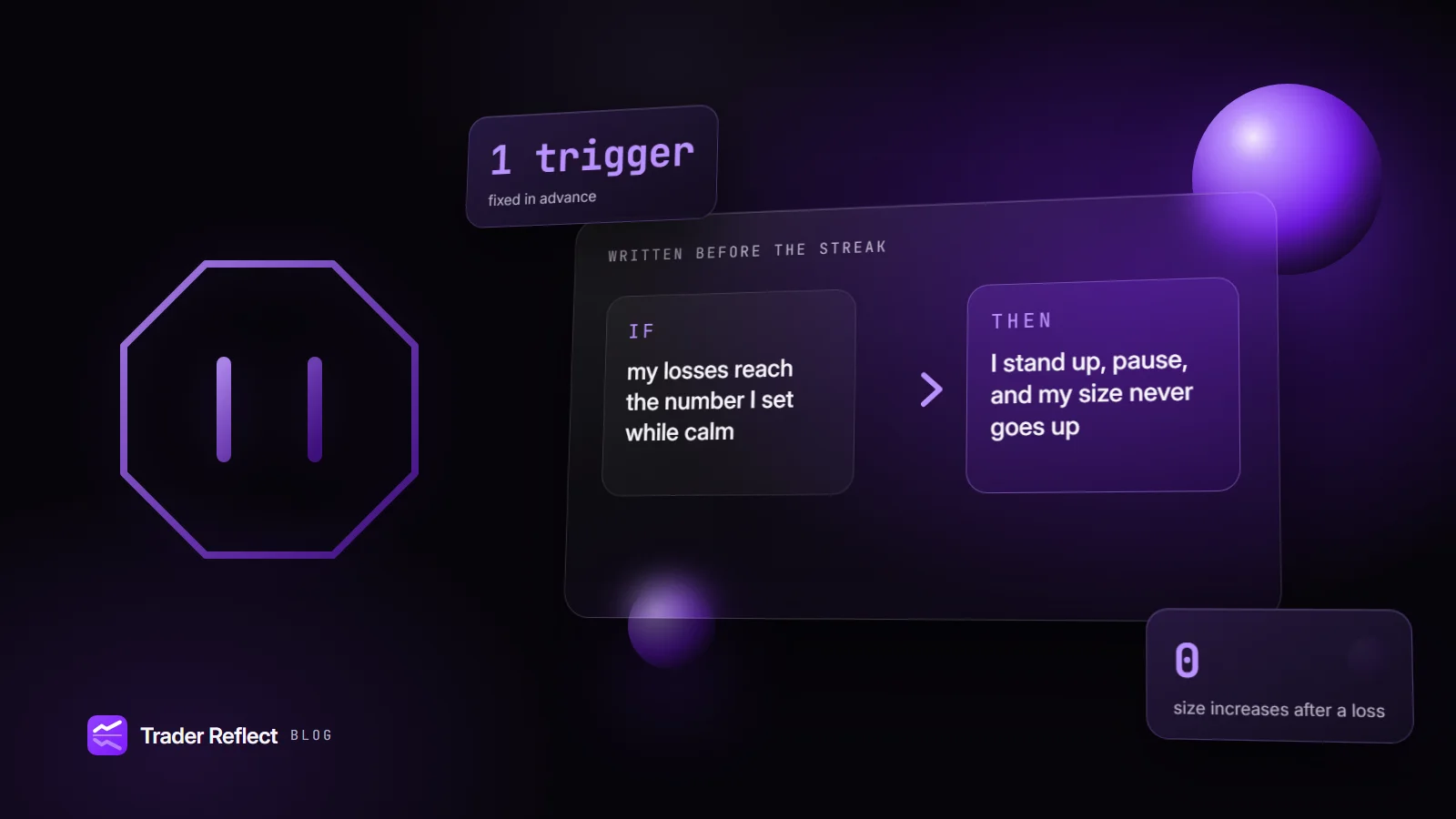
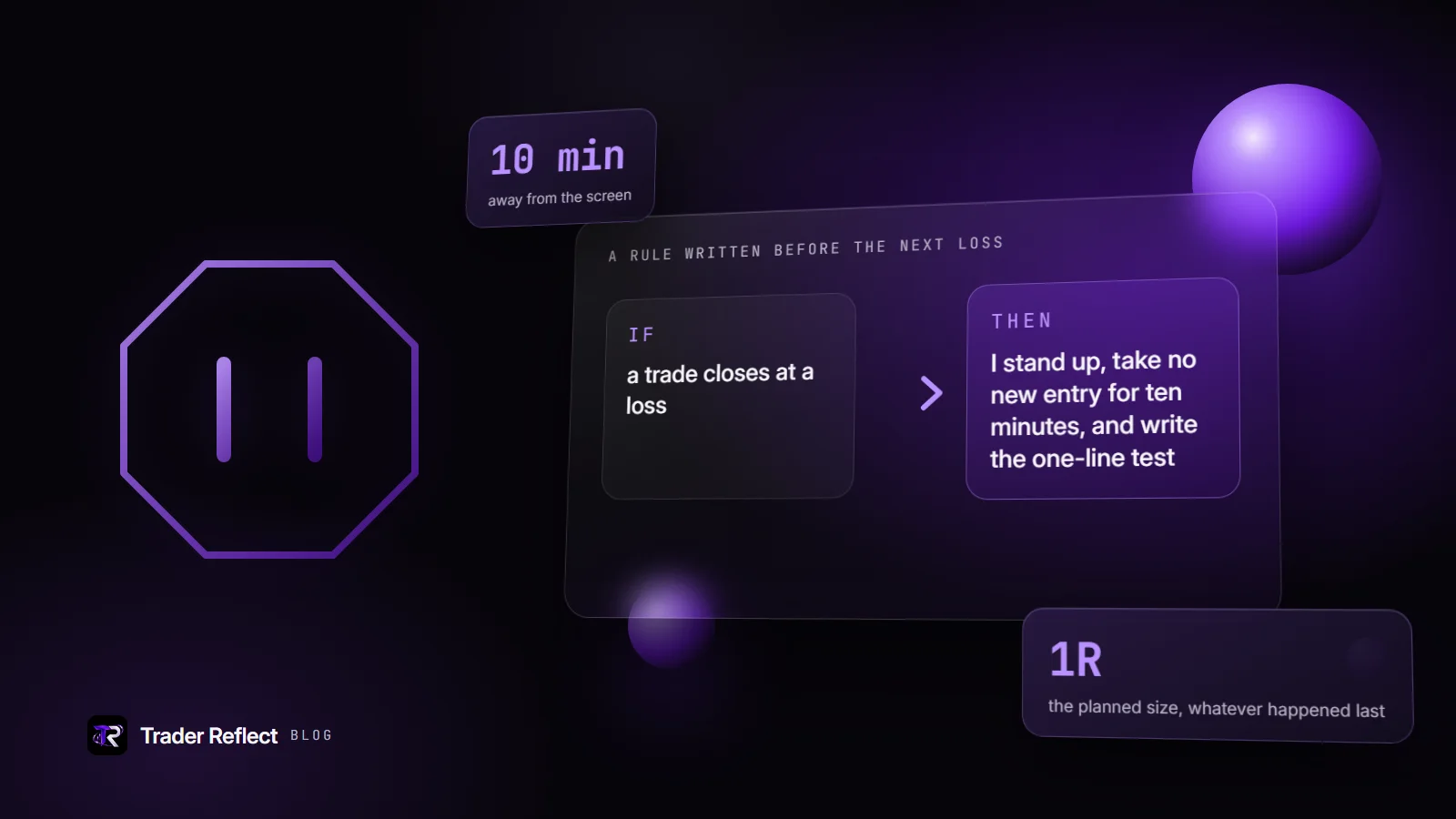
The pause length is yours to choose and to write down: ten minutes after a loss, or the rest of the session after two breaches of the plan. Whatever you choose, it should be a number, not "when I feel better". Feeling better is exactly what tilt makes unreliable.
If-then wording works well here: if I have two trades in a row that break my plan, then I close the platform for the day. The post on if-then plans shows how to write one so it can be checked afterwards.
Limits that do the work for you
A reset relies on you noticing. A limit does not. Set a rule that triggers on facts, not on feelings: a maximum number of trades, a daily loss in R at which you stop, a mandatory break after a stop-out. The post on the daily loss limit as a habit goes into how to make one stick.
Facts-based limits matter because tilt lowers your ability to judge your own state. You will rarely feel tilted; you will feel justified.
What to measure afterwards
After a few weeks, check whether the reset is being used and whether it helps:
- On how many sessions did a reset trigger, and how many times did you actually run it?
- What happened to the next trade after a reset, compared with a similar moment where you did not run one?
- Did the count of plan breaches on those days fall?
Keep the claims modest. A few sessions will not tell you whether the reset works; they will tell you whether you use it. Use is the first thing to fix. If you never run it, make it shorter or tie it to a clearer trigger. The entry on streaks is a reminder that runs of results look meaningful long before they are.
Common ways this fails
- Writing the reset while upset. Write it on a calm day and keep it where you will see it.
- A reset that needs willpower. Prefer "close the platform" to "try to stay calm".
- No consequence. If breaching the plan twice has no effect, the rule is advice, not a rule.
- Treating it as a morality test. Tilt happens to disciplined traders. The point is the response.
- Ignoring the win side. Check your record after good days too.
Where Trader Reflect fits
Trader Reflect reads your own trades and names the habit that costs you most, with the number of trades behind it, so you can see whether it clusters after losses or after wins. It does not tell you what to trade. If your trades live in the Money Circle journal, you can open Trader Reflect from your Money Circle Journal and see what membership includes. For a second view on the discipline side, Money Circle's guide to why beginners overtrade and how to stop is a useful companion.
Educational content, not financial advice. Trading involves risk of loss.